Weaponizing Memory: Western Revisionism and the Securitization of History for Geopolitical Ends
Western institutions are weaponizing the memory of the Second World War to fit current geopolitical aims, distorting history and creating moral, democratic and strategic blind spots.

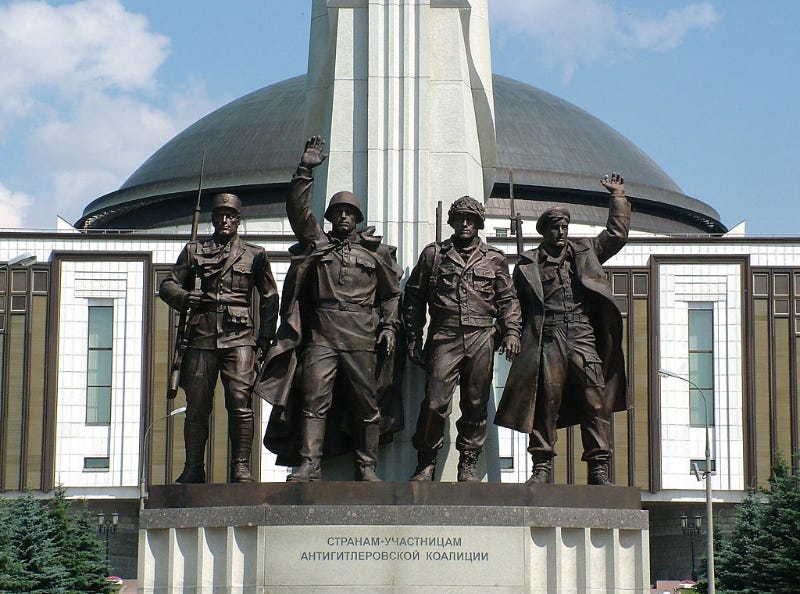
Every time I visit Moscow, I make it a point to walk through Victory Park (Парк Победы) on Poklonnaya Hill and the Aleksandrovsky Gardens. I do not go as a tourist. I go as a student of the Second World War, having spent years studying the Eastern Front and its human cost. Standing before the Eternal Flame, walking past the long granite walls etched with the names of cities reduced to rubble, one is struck less by spectacle than by silence. Victory Park is not triumphal in spirit. It is solemn. It is a place where memory is a sacred inheritance - not an abstraction, not a rhetorical device, but a lived continuity between generations.
To walk there is to confront scale: 27 million dead. Entire regions erased. Families extinguished. Whatever one thinks of the Soviet political system, the memory of that sacrifice occupies a foundational place in Russian historical consciousness. It is not merely history. It is civilizational memory.
Yet, outside Russia, the meaning of that memory is shifting. History is no longer about what happened. It is about who and what is being allowed to be remembered. It is being reclassified as a security domain. Across the West, memory is no longer treated primarily as a field of inquiry that is contested, archival and necessarily uncomfortable, but as a terrain of geopolitical alignment. Certain interpretations are framed as stabilizing, others as dangerous. Commemoration becomes policy and “correct remembrance” a loyalty signal. Once history is scrutinized this way, nuance ceases to be a scholarly virtue and becomes a liability.
Nowhere is this transformation more visible than in the West’s recoding of twentieth-century Eurasian history, especially the Second World War and its aftermath, into a simplified moral grammar. This recoding sustains a series of concrete, documentable cases of selective revisionism and factual distortion. It also reflects identifiable institutional drivers and is creating strategic blind spots that liberal societies are poorly equipped to recognize.
The logic of this recoding becomes clearest when one examines how it has been formalized at the institutional level.
Europe’s Recasting of the Soviet Union as Nazi Germany’s “Twin”
The European Parliament’s 2019 Resolution on the Importance of European Remembrance for the Future of Europe1 does more than commemorate the past. It rewrites it. By declaring that the Second World War was “started as an immediate result” of the 1939 Nazi–Soviet Pact and equating Nazi Germany and the Soviet Union as symmetrical “totalitarian” perpetrators, the resolution rewrites causation. By further framing alternative historical interpretations as “information warfare,” it recodes twentieth-century history to fit present geopolitical alignments.
This framing is false at the level of causation. Attributing the war’s outbreak to the Molotov-Ribbentrop Pact erases the decade of European appeasement that made Hitler’s aggression possible: the remilitarization of the Rhineland, the Spanish Civil War, the Anschluss, Munich and the dismantling of Czechoslovakia.
It also omits the collapse of the last serious attempt to prevent war. Michael Jabara Carley, one of the leading historians of interwar diplomacy and a scholar deeply grounded in the archival record of that period, offers an account of early 1939 that reads almost like an indictment. In his work 1939: The Alliance That Never Was and the Coming of World War II, he argues that as Hitler dismantled the European order, the Soviet Union advanced a concrete proposal on April 15, 1939, for a binding military alliance aimed at deterring German aggression. Yet, London stalled, Paris hedged and Warsaw refused even the practical necessity of allowing Soviet transit in the event of invasion. Anti-communist suspicion outweighed the urgency of the Nazi threat. In Carley’s telling, the Western powers chose to gamble on Hitler rather than forge an alliance with the USSR. The price of that hesitation was paid within months. From Moscow’s perspective, the Pact with Germany followed the exhaustion of diplomatic alternatives with London, Paris and Warsaw, not ideological convergence with Nazism.2
This was later acknowledged by Winston Churchill himself. In his memoir-history work The Second World War, vol. I, The Gathering Storm, he conceded that there was “no means of maintaining an Eastern Front against Germany without the active participation of Russia,” and that had such an alliance been concluded, “the whole course of events might have been changed.”3
By presenting the Nazi–Soviet Pact as the war’s “immediate” cause, the European Parliament resolution excises Western diplomatic failure and reallocates moral responsibility eastward. This erasure enables the resolution’s deeper move of moral equivalence. Nazi Germany, a genocidal regime committed to racial annihilation, and the Soviet Union, a repressive system that nonetheless bore the main military burden of destroying the Third Reich, are collapsed into a single category. The Red Army’s decisive victories on the Eastern front are marginalized to sustain symmetry. Memory is flattened, causation is inverted and history is securitized. What emerges is not remembrance, but alignment where history is repurposed as policy.
Blinken at Babi Yar: Holocaust Memory as a Geopolitical Weapon
The most striking individual example of Western memory distortion remains former US Secretary of State Antony Blinken’s 2023 statement marking the anniversary of the Babi Yar massacre. Blinken wrote:
“Eighty-two years ago, Nazis murdered 34,000 Jews at Babyn Yar. The Soviets buried this history, which today Putin’s government manipulates to provide cover for Russia’s abuses in Ukraine.”4
The crime itself is undisputed. What is distorted is the charge of “burial”. Soviet investigators documented the Babi Yar killings as early as 1944 through the Extraordinary State Commission, incorporating them into war-crimes dossiers and postwar trials. Victims were typically described as “Soviet citizens” rather than explicitly as Jews. This was an ideological distortion and historians like Karel Berkhoff have shown how Soviet wartime propaganda universalized Jewish suffering for political ends.5 However, the massacre was not suppressed, concealed or denied. It entered official investigation, legal record and public awareness, albeit within a constrained interpretive framework.
That framework reflected Soviet nationality policy. The Soviet state did not conceptualize the war primarily through ethnic victimhood or the Holocaust as a distinct category. Nazi crimes were universalized as violence against the Soviet people as a whole. Emphasizing Jewish specificity at Babi Yar risked foregrounding ethnic division, while highlighting Ukrainian nationalist collaboration risked inflaming inter-nationality tensions within a fragile, multiethnic state. The result was moral distortion, not erasure.
These limits were openly challenged in 1961, when the poet Yevgeny Yevtushenko’s poem Babi Yar publicly confronted both Nazi atrocity and Soviet antisemitism, igniting national debate. Blinken’s formulation collapses this layered history into a narrative of “burial,” converting ideological constraint into complicity and repurposing Holocaust memory as a bridge to contemporary geopolitical messaging against the modern Russian state.
Normalizing Collaboration: The Canadian Waffen-SS Scandal
On September 22, 2023, members of Canada’s House of Commons, in the presence of then–Prime Minister Justin Trudeau, gave two standing ovations to Yaroslav Hunka, who was introduced as a WWII-era Ukrainian-Canadian who had fought “for Ukrainian independence against the Russians” during the Second World War. It soon emerged that Hunka had served in the Nazi 14th Waffen-SS Grenadier Division “Galicia,” prompting domestic outrage, international condemnation and the resignation of Speaker Anthony Rota.6 It is striking that members of the House of Commons who joined the standing ovation appeared to overlook that Canada and the Soviet Union were wartime allies within the Grand Alliance against Nazi Germany.
The episode acquired an additional layer of historical irony through the participation of Ukrainian President Volodymyr Zelensky, who joined the ovation. Zelensky’s own grandfather, Semyon Ivanovich Zelensky, was a decorated Red Army officer who fought Nazi Germany and received two Orders of the Red Star in 1944 for personal heroism in combat. While one generation of the Zelensky family fought as part of the Soviet force that destroyed the Third Reich, the next stood in applause for a man who had served in a Waffen-SS formation subordinated to that same regime. The juxtaposition is emblematic rather than personal. It illustrates the degree to which historical reference points have been reordered.
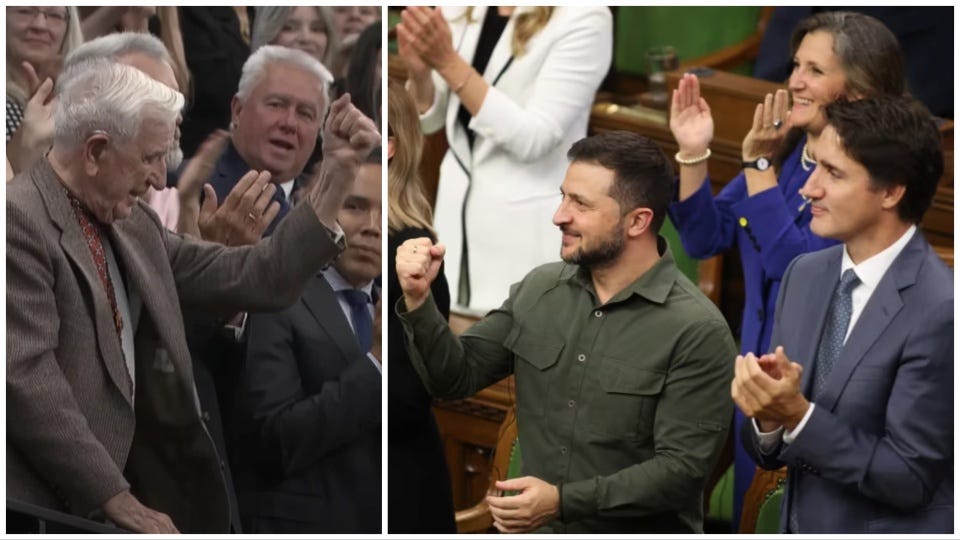
Such inversions are only possible within a memory regime in which the Soviet Union is remembered primarily as an occupier rather than as a principal force in the defeat of fascism, and in which Russia is recast not as a historical co-victor but as a civilizational antagonist. The Hunka ovation thus stands as a concentrated expression of how wartime categories of perpetrator, collaborator and liberator are being destabilized under the pressure of present-day strategic alignment.
From Revisionism to Falsification: Recent Public Claims
Some contemporary claims do not merely re-interpret but outright falsify. In a December 2025 interview with the Kyiv Post, the Austrian aristocrat Karl von Habsburg asserted that Russia “was not exactly successful” in major conflicts and explicitly listed the Second World War and the Winter War with Finland as wars that Russia “lost”.7
The statement is not a matter of angle or emphasis but a categorical reversal of basic outcomes. The USSR was the principal victor against Nazi Germany and the Winter War ended with Finnish concessions of territory as part of the Moscow Peace Treaty, despite Finnish battlefield performance and Soviet costs. The significance is diagnostic in that the rhetorical convenience of portraying Russia as historically “losing again and again” overrides elementary factual structure.
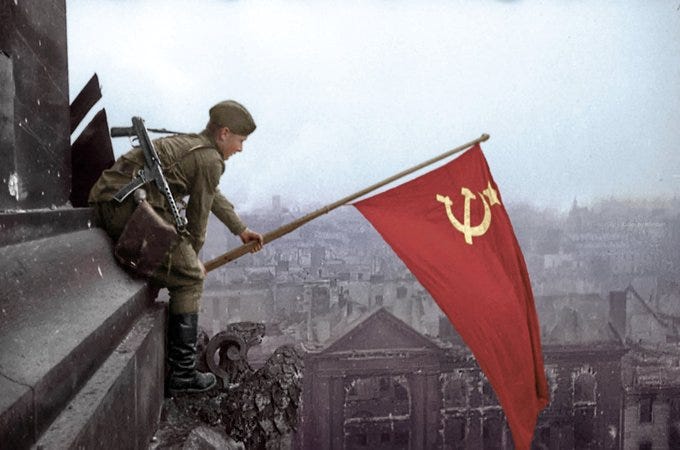
Similarly, EU High Representative Kaja Kallas’s previous statements that it is “something new” to claim Russia and China fought and won the Second World War, and that Russia “attacked 19 countries in the last 100 years”, are emblematic of this discursive environment.8 Finnish Foreign Minister Elina Valtonen used the same formulation of Russia attacking 19 countries but none attacking Russia, in public messaging.9 As I and many other authors have analyzed in previous essays, these claims collapse basic historical realities and substitute them with convenient geopolitical narratives. The claim that no country has attacked Russia in a century collapses on contact with June 1941, when Germany, Italy, Finland, Romania, Hungary, Slovakia and Albania all formally declared war on the Soviet Union and joined Hitler’s invasion as part of his war of extermination.
The contrast with the West’s own wartime record is stark. In November 1943, at the height of the US–Soviet alliance, the US Department of War released “Why We Fight: The Battle of Russia”, an official orientation film produced under Frank Capra for American troops and later shown to civilian audiences. The documentary was produced following Soviet victories at the battles of Moscow, Stalingrad and Kursk. The film opens with unequivocal statements by senior American political and military leaders recognizing the decisive role of the Red Army and its centrality in the fight against Nazi Germany. The first minute of the film’s opening is captured below. The full documentary is publicly available.
Far from marginal, the film won the Academy Award for Best Documentary Feature in December 1943, reflecting mainstream wartime acceptance of this assessment. Irrespective of its propagandistic intent, the film stands as a primary-source record of official US wartime acknowledgment of the Soviet contribution, underscoring how far Western discourse has since shifted from recognition to revision.
This assessment is not confined to wartime messaging. As a matter of historical record, major Western scholarship likewise treats the Eastern Front as the principal theater of Germany’s land war and the Red Army as the force that bore the heaviest share of the fighting - an interpretation widely supported by historians like Stephen Cohen, Michael Jabara Carley, David Glantz, Antony Beevor, A. J. P. Taylor, John Keegan and Paul Kennedy.
When Culture Becomes a Battlefield: Institutionalized Russophobia After February 2022
After February 2022, the weaponization of memory extended beyond resolutions and rhetoric into the cultural sphere. Russian language, literature, music and art were increasingly treated not as politically sensitive, but as morally suspect. The implicit message was that Russian culture no longer belonged to a shared European or human inheritance, but constituted an adversarial presence to be removed from public space.
The performing arts provided early signals. On March 1, 2022, the Polish National Opera cancelled Mussorgsky’s Boris Godunov. Days later, the Cardiff Philharmonic Orchestra removed Tchaikovsky’s 1812 Overture from a scheduled program, a move later echoed by the San Diego Symphony Orchestra*. These cancellations targeted canonical works composed long before the modern Russian state and bearing no connection to contemporary politics, functioning instead as symbolic acts of cultural sanction.
Museums followed a similar logic. In Britain, the Museums Association endorsed suspending cooperation with Russian institutions, freezing exhibitions and loans nationwide. In Spain, Reuters documented the return of Russian artworks after exhibitions were postponed under political pressure.10
The long-term danger is structural. When cultural institutions abandon the principle that art transcends state power, they impoverish liberal culture itself. By teaching societies to associate a people’s language and artistic tradition with inherent threat, Western institutions erode the universalism they claim to defend.
Structural Drivers of Western Historical Revisionism
Several structural forces have enabled the normalization of historical revisionism in Western political culture. Foremost is the erosion of expertise. Since the 1990s, sustained cuts to area studies and foreign-language programs, particularly those focused on Russia, Eastern Europe and China, have hollowed out institutional knowledge. Linguistic competence and archival familiarity have given way to a foreign-policy discourse dominated by generalists operating within an English-language media and policy ecosystem, where repetition substitutes for evidence and inherited assumptions go largely unchallenged.
Closely linked is the collapse of historical education itself. Undergraduate history degrees have declined sharply across the United States and Europe. By 2019, the number of history BAs in the United States had fallen by nearly half from late-2000s levels. A public without training in source criticism, historiography, or causal reasoning is poorly equipped to distinguish archival scholarship from strategic narrative. This deficit is widely understood by political elites. Under such conditions, false or selective histories need not be sophisticated. They need only be repeated by credentialed voices.
A third enabling factor is the securitization of memory. The European Parliament’s 2019 resolution explicitly frames historical remembrance as part of a counter-disinformation strategy directed at Russia, collapsing the boundary between scholarship and security policy. Once history is treated as a domain of resilience rather than inquiry, disagreement becomes suspect, nuance destabilizing and interpretation a matter of political alignment. Memory ceases to constrain power and instead becomes an instrument of statecraft.
Finally, these trends converge in a condition of generational amnesia. Public surveys show a marked deterioration in basic historical literacy, including knowledge of the Holocaust. A 2020 US study found that nearly two-thirds of millennials and Gen Z respondents could not identify Auschwitz.11 If even the most extensively documented genocide is fading from public understanding, the far more complex histories of the Eastern Front or China’s wartime resistance are especially vulnerable to distortion. In such an environment, revisionism is not merely easier to impose; it is harder to detect.
Taken together, these conditions create a public sphere in which history no longer functions as a discipline capable of checking power. Instead, it becomes a set of authorized talking points governed from above. The result is a society increasingly vulnerable to manipulation, where dissenting interpretations are recoded not as scholarship but as deviation.
Consequences: Strategic, Moral and Democratic Dangers
The consequences of historical revisionism extend beyond interpretive error to concrete political risk. A West that erases or trivializes Russian and Chinese wartime trauma - Russia’s 27 million dead and China’s 35 million between 1931 and 1945 - will misread contemporary security behavior. When these experiences are denied legitimacy, the strategic red lines shaped by them appear irrational or fabricated, increasing the risk of miscalculation and escalation rather than restraint.
The moral costs are equally severe. As memory is reshaped to fit present geopolitical alignments, historical categories invert. The rehabilitation of anti-Soviet collaborators, exemplified by the Hunka scandal, shows how actors once aligned with genocidal violence can be reframed as symbols of resistance when they fit the current enemy narrative. In such a climate, memory itself becomes collateral damage, subordinated to strategic convenience.
This process also corrodes democratic culture from within. Governments that instrumentalize history while professing liberal values undermine trust in democratic discourse. The securitization of memory turns historical debate into a loyalty test, narrowing the space for legitimate dissent. When official narratives are enforced rather than contested, citizens learn not to reason historically but to align politically.
Western states routinely accuse Russia and China of manipulating history. Yet, credibility requires confronting the West’s own revisionism. The Soviet Union and China were indispensable to the defeat of fascism. Their contributions are foundational to the modern international order. Erasing or distorting this reality weakens not only historical integrity but the moral authority of those who claim to defend it.
Resisting this trajectory demands more than rhetorical balance. It requires reinvestment in historical education, the rebuilding of area-studies expertise and a firm defense of scholarly autonomy from geopolitical agendas. Without these correctives, North America and Europe risk becoming societies that no longer understand how they survived the twentieth century and are therefore poorly equipped to avoid repeating its disasters.
If this essay helped you see patterns that mainstream narratives obscure, subscribe.
Free subscribers stay in the conversation. Paid subscribers make the research possible and receive in-depth, archival essays that examine power, coercion and diplomacy beyond the constraints of algorithm-driven media.
European Parliament. “European Parliament Resolution on the Importance of European Remembrance for the Future of Europe.” September 19, 2019.
MacKenzie, David., From Messianism to Collapse: Soviet Foreign Policy, 1917-1991, Harcourt Brace College, Publishers, 1994, p. 88
Churchill, Winston., “The Gathering Storm”, Boston, 1948, pp. 362-65
Blinken, Antony. “Statement on the 82nd Anniversary of the Babyn Yar Massacre.” US Department of State, September 29, 2023.
Berkhoff, Karel C. “Motherland in Danger: Soviet Propaganda During World War II.” Harvard University Press, 2012.
Associated Press. “Leader of Canada’s House of Commons apologizes for honoring man who fought for Nazis.” September 24, 2023.
Kyiv Post. “A Warning Against Appeasement – Interview With Karl von Habsburg (Part II).” December 22, 2025.
European External Action Service (EEAS), “Foreign Affairs Council (Defence): Press remarks by High Representative Kaja Kallas upon arrival” (statement referencing “19 countries… invaded in the last 100 years”).
Embassy of Finland, Washington, D.C. (@FinlandinUSA), X (Twitter) post quoting Foreign Minister Elina Valtonen: “Russia has invaded 19 countries…” December 2025.
Museums Association. “Cultural loans and partnerships with Russia halted over war in Ukraine.” March 11, 2022.
Claims Conference. “U.S. Millennial Holocaust Knowledge and Awareness Survey.” New York, 2020.
"From Moscow’s perspective, the Pact with Germany followed the exhaustion of diplomatic alternatives with London, Paris and Warsaw, not ideological convergence with Nazism."
Ask anybody in your life if they have ever heard of Maxim Litvinov and "Collective Security" against Nazis. Answer will probably be close to 100% "No". Jabara's work is nicely trashing the myth of poor little Poland.
The problem with history studies, at least back home, is that there are no decent jobs. People are encouraged to do IT, whereas elites are handling the historical memory. Now, who are these elites at the EU level that are dictating the narrative? People like VdL, Merz, Baerbock, Kallas, Landsbergis and similar characters back home. Revisionist Nazi and quisling posterity.
Before Putin elevated local event of "Immortal Regiment" to the national level and before it went globally, our lot was gloating how soon WWII veterans would all be gone. "Immortal Regiment" preempted this, luckily.
Wonderful take on an essential topic. And although it raises so many important points, one could still add many others: the elevation of the ‘holodomor’ narrative to the status of a European civic religion, the painting of Russia as the worst colonial power in history … most of it has been around for a long time, but the most blatant distortions have never been trumpeted as shamelessly as now.
Still, I slightly object to your idea this is widely the consequence of a decline of historical knowledge (although it is undeniable that standards both in academic and popular knowledge are rapidly eroding). It is a conscious reinvention of history - not only in the service of foreign policy, but of a deeper ideological agenda. That's at least how it looks from a German perspective - no doubt most Germans always wanted to imagine themselves as victims of the eastern barbarians, but it was long deemed unacceptable to voice it too openly. I am nevertheless shocked by how enthusiastically all these guardrails have been torn down over the last ten years. Historians specialized in Eastern Europe are marching at the forefront - so it's not just ignorance (their professional identity was always primarily about producing anti-soviet propaganda). But it goes beyond that - I can assure that regular Germans love to blubber "Russia is a fascist state" with all signs of relief - the relief of a violent criminal who can openly blame his victim for his atrocities and get acclaim for it.