The Enduring State: Why Iran's Protests are Unlikely to Induce Regime Change
Iran's protests reflect deep social and generational strain, but absent unified leadership, elite fracture and a credible alternative order, they challenge the system without becoming a revolution.

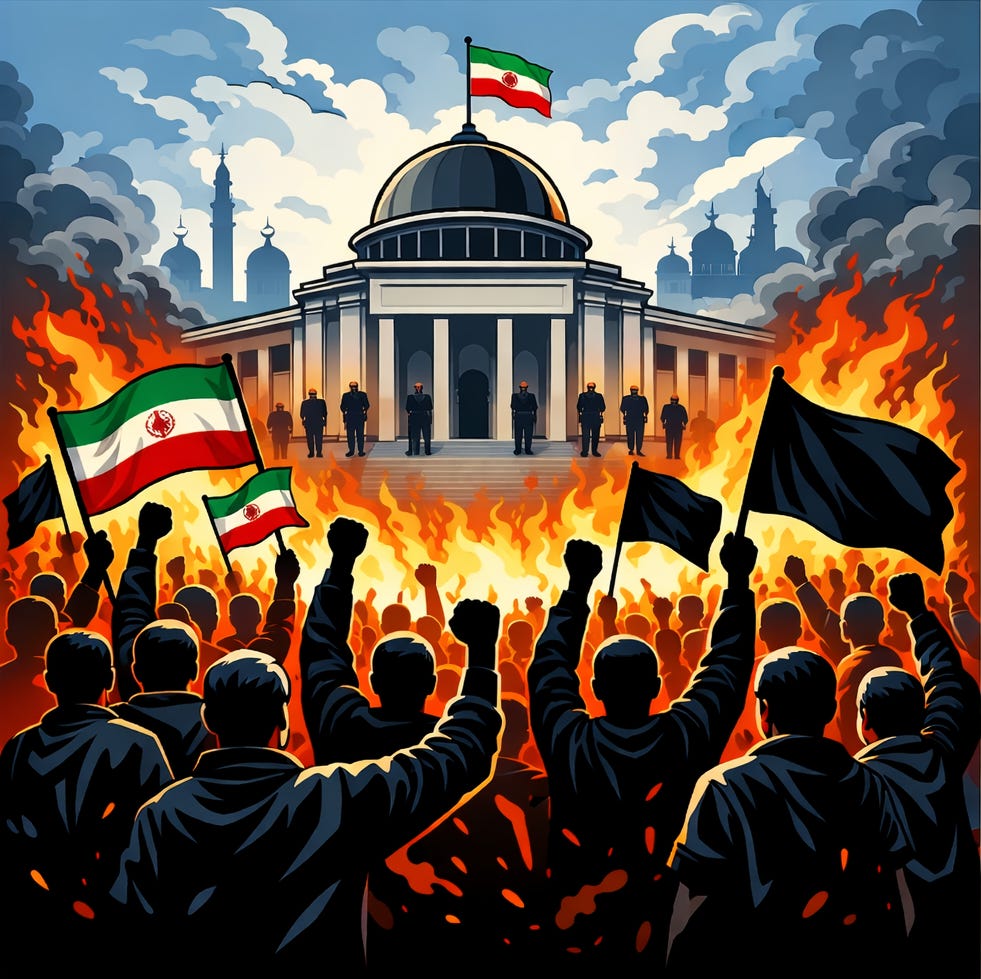
Moments of mass protest in Iran tend to appear suddenly, but they are almost always the product of pressures that have accumulated over years. The current wave was immediately triggered by a sharp currency shock that plunged the Iranian rial to historic lows of 1.4-1.5 million per US dollar on unofficial markets.1 This rapid depreciation eroded purchasing power almost overnight, making basic goods feel abruptly unaffordable. That economic jolt transformed latent frustration into street mobilization, first in commercial centers and then across cities nationwide.
Yet, the scale and geographic spread of the protests cannot be explained by the currency collapse alone. They reflect a convergence of deeper structural strains in the form of prolonged economic hardship under sanctions, persistently high inflation now exceeding 40 percent, mismanagement, generational frustration and a widening dissonance between official norms and lived social reality. Demonstrations have spread beyond Tehran to provincial cities and university towns, signaling diffuse dissatisfaction rather than a coordinated national movement. Protest slogans range from economic grievances to cultural protest to outright political rejection.
The timing is critical. Iran is absorbing overlapping shocks from sustained sanctions, post-pandemic strain, regional insecurity and a generational transition increasingly detached from revolutionary-era legitimacy. These pressures are compounded by heightened external signaling, most notably President Trump’s recent “locked and loaded” warning, made more credible by the June 2025 attacks on Iran by the United States and Israel, which broke a long-standing deterrence barrier. Together, these dynamics have reduced the state’s ability to absorb economic shocks, allowing grievances that might once have remained localized to spread rapidly across regions and social groups.
While the protests are among the most serious and disruptive since the 2022 Mahsa Amini (“Woman, Life, Freedom”) uprising, seriousness should not be confused with imminence. Iran has experienced multiple waves of mass protest over the past two decades, some comparable in scale. What defines the present moment is not unprecedented mobilization, but persistent structural strain. Whether such strain leads to regime collapse depends not on protest alone, but on whether the deeper conditions for revolutionary transformation are present - a distinction often lost in Western media narratives that equate visible unrest with imminent regime change.
Protest Versus Revolution: A Conceptual Distinction
Protest, even when sustained and widespread, is not revolution. History draws a clear distinction between the two. Revolutions are rare, system-shattering events that overturn entire political, economic and social orders. They do not arise automatically from hardship, repression or visible unrest, nor are they spontaneous eruptions of anger.
Protest movements can persist for years, even at high levels of disruption and under intense external pressure, without becoming revolutionary. This is not a claim about political equivalence, but about political mechanics. In Venezuela, prolonged economic collapse, repeated nationwide protest waves, escalating US sanctions and even the recent US abduction of President Nicolás Maduro have not produced regime collapse. The governing apparatus endures because its coercive core remains intact and no credible successor authority has emerged.
Similar dynamics were visible in Belarus after the 2020 election, where mass demonstrations erupted after widely contested results but were ultimately suppressed over years without dislodging President Alexander Lukashenko amid ongoing Western sanctions. In Nicaragua after 2018, sustained public mobilization and international isolation likewise failed to translate into regime replacement in the absence of elite defection or parallel centers of coercive authority. Taken together, these cases reinforce a consistent rule: even when economic collapse, moral delegitimization and external pressure converge, prolonged dissent more often yields repression, reform, or elite recomposition than revolutionary authority capable of overturning an entire system.
The analytical error common in Western commentary is to collapse protest into revolution by equating visibility with viability. Large crowds, persistent demonstrations and emotionally charged slogans are treated as prima facie evidence of imminent regime collapse. This misreads the mechanics of revolutionary change and overstates the political power of mobilization alone. Noise is not power, and protest does not confer governing authority. This misperception underpins many external assumptions about regime change in Iran, where protest is often mistaken for revolutionary capacity.
Across history, successful revolutions share two indispensable features. First, they require a legitimate coordinating center - an authoritative leader or cohesive institutional network - capable of converting mass agitation into durable governing authority. Such leadership must be widely recognized as authentic and representative, commanding loyalty beyond activist circles and into core social classes and institutions. Second, they must offer a coherent alternative order that addresses the root causes of grievance. Revolutions replace systems. They do not merely negate them.
Absent these conditions, protest fragments, dissipates, or is absorbed by the system it confronts. Even sustained unrest may impose costs or force concessions, but without a legitimate leadership core and an alternative governing project, it rarely culminates in revolutionary transformation.
Revolutions Overthrow Systems, Not Just Governments
The French Revolution of 1789 dismantled feudal monarchy, aristocratic privilege and clerical dominance, replacing them with a radically new conception of citizenship and sovereignty. The Bolshevik Revolution of 1917 destroyed the tsarist autocracy and capitalist landholding system, substituting a centralized socialist state. The Iranian Revolution of 1979 eliminated monarchy and secular authoritarianism, installing a clerical republic rooted in Shi’a ideology.
Despite ideological differences, these revolutions shared a common pattern: they replaced entire systems of governance at political, economic and social levels. None were leaderless. None were ideologically vague. None depended on foreign sponsorship to succeed.
Collapse Without Replacement: Libya and Syria as Cautionary Cases
It is essential to distinguish systemic revolution from other pathways of regime collapse. Governments can fall without producing a revolutionary transformation, most notably through state breakdown driven by prolonged war, coercive fragmentation or foreign intervention, as seen in Libya in 2011 and more recently in Syria. In these cases, the collapse of central authority did not yield a new, coherent governing order, but rather the disintegration of the state itself. Power fragmented among militias, warlords and external patrons, producing instability rather than a legitimate successor system. Such outcomes differ fundamentally from revolutions, which replace one integrated political and social order with another capable of exercising authority.
Applied to Iran, this distinction matters. While regime collapse without a revolutionary alternative is theoretically possible, it would require Syria- or Libya-style coercive fracture and external escalation - conditions that are not presently evident. Unlike Syria, where armed groups seized and held territory, or Libya, where rival militias dismantled central authority along regional and tribal lines, Iran shows no signs of territorial disintegration or organized secessionist warfare. No armed movements are contesting state control in pursuit of breakaway regions, nor are parallel authorities attempting to supplant the central government. Absent territorial fragmentation, elite military defection, or competing centers of coercive power, protest alone cannot produce state collapse, let alone a viable post-collapse order.
The External Escalation Argument and Its Limits
A related critique holds that Iran could nonetheless be pushed toward a Syria- or Libya-style collapse if internal unrest were exploited by the United States and Israel through renewed or escalatory military action aimed at fragmenting the state or coercing compliance. This risk cannot be dismissed outright, but it is frequently overstated.
Unlike Libya or Syria, Iran retains a unified military command, layered internal security architecture and a political system explicitly designed to withstand the combined pressures of external attack and internal dissent. External military pressure has also historically tended to consolidate rather than fracture Iranian state cohesion by activating nationalist and sovereignty-based legitimacy - a dynamic visible during Israel’s June 2025 attacks and the US bombing of nuclear sites, which failed to trigger elite defection or popular revolt. For Iran to follow a Syria- or Libya-like trajectory would require sustained warfare capable of breaking the cohesion of its security institutions and producing rival centers of armed authority. Such an escalation would entail regional conflagration and prohibitive strategic costs for the intervening powers themselves.
Governing Questions and Revolutionary Answers
A defining feature of successful revolutions is their ability to answer foundational questions of governance - something entirely absent from the current unrest. The 1978–79 Islamic Revolution did precisely this. It articulated a clear answer to the question of state structure, replacing monarchy with an Islamic Republic that combined elections and representative institutions with clerical guardianship.
It addressed economic distribution by framing justice around the redirection of power and wealth away from a court-centered elite toward the “oppressed,” legitimizing nationalization, redistribution and state-led development in moral as well as political terms.
It advanced a national security doctrine grounded in revolutionary legitimacy, mass mobilization and independence from foreign patrons, explicitly shaped by the memory of the 1953 Mossadegh coup and fears of counter-revolution.
Finally, it defined Iran’s place in a hostile regional environment through a foreign policy identity that rejected client-state alignment, proclaimed “neither East nor West,” and cast sovereignty and resistance as pillars of national dignity.
It was this capacity to confront and answer core questions of governance - not protest alone - that allowed the revolution to consolidate power and endure.
Do Current Iranian Protests Meet These Conditions?
Measured against this historical standard, the current protests in Iran fall short. There is no unified leadership that is visible yet, and that is capable of mobilizing the nation. Opposition figures abroad lack legitimacy inside Iran, while domestic dissent remains fragmented across class, region and ideology. The protests are emotionally powerful but organizationally diffuse.
Nor is there a coherent alternative system being proposed. Current protest slogans express moral outrage, economic stress or cultural frustration, but they do not articulate a governing model capable of replacing the Islamic Republic. Calls for “freedom” or “regime change” are not political programs. They do not address questions of state structure, economic distribution, national security or Iran’s place in a hostile regional environment - questions that the 1978-79 Islamic Revolution, whatever one thinks of its outcomes, confronted directly.
What is often left implicit is that a revolution in Iran would have to dismantle not merely a ruling elite, but an entire economic, legal and social order in which clerical authority is embedded across the judiciary, security apparatus, welfare system and major sectors of the economy. There is no credible evidence that the current protest movement has articulated, let alone organized around, a replacement for this deeply institutionalized model of governance.
Equally important, Iran’s state apparatus has not fractured. The security forces, clerical institutions and core administrative structures remain intact. Revolutions require elite defection. This has not occurred.
The Reza Pahlavi Question and the Problem of External Legitimacy
Any assessment of revolutionary potential must confront the question of alternative leadership. Among figures amplified in Western media, Reza Pahlavi, the son of the last Shah, is often portrayed as a unifying symbol or latent national leader. Recent GAMAAN polling conducted inside Iran shows that roughly 31 percent of respondents selected Pahlavi when asked to identify a preferred political figure, placing him ahead of other named opposition figures, but well short of majority support and unevenly distributed across gender (36 percent among men and 27 percent among women) and age cohorts.2 This level of backing is better understood as symbolic and episodic, reflecting moments of protest-driven negation and frustration with existing order rather than consolidation of durable, system-replacing revolutionary legitimacy.
Survey visibility also does not equal governing authority. Unlike successful revolutionary leaders in France, Russia or Iran itself, Pahlavi lacks embedded legitimacy within Iran’s social, institutional and ideological structures. He commands no domestic organization, leads no mass movement inside the country and is anchored in none of the religious, military, labor or political institutions that historically determine revolutionary outcomes. His support remains concentrated in diaspora and Western political circles, which further undermines rather than reinforces his standing inside Iran.
The contrast with historical revolutions is decisive. Vladimir Lenin’s authority in 1917 rested on a disciplined party embedded in factories and soldiers’ councils; Ayatollah Khomeini’s in 1978–79 on decades of clerical standing and a nationwide religious network capable of mobilizing society and neutralizing the state. Mao Zedong similarly commanded a mass-based revolutionary party fused with peasant mobilization and a guerrilla army that exercised territorial control long before state power collapsed. Ho Chi Minh combined nationalist legitimacy with a tightly organized party-state and military apparatus that embedded itself across villages, unions and resistance networks during decades of anti-colonial struggle. Even the French Revolution, despite lacking a single leader at its outset, possessed institutional centers capable of translating mobilization into governing power.
There is no credible public evidence that Pahlavi offers any of these. His appeal is primarily oppositional rather than programmatic, defined by rejection of the Islamic Republic rather than by a coherent governing alternative rooted in Iran’s contemporary realities. Proposals advanced in his name do not address the core questions of authority, security, economic distribution and sovereignty that revolutions must resolve.
Pahlavi’s rising visibility in surveys and protests therefore signals not revolutionary momentum but the absence of a credible indigenous leadership core. As the collapse of Russia’s Provisional Government under Alexander Kerensky following the February 1917 revolution illustrates, international recognition cannot substitute for deep domestic legitimacy and organized governing power. Until such leadership emerges, protest in Iran will remain politically indeterminate rather than transformative.
Domestic Dissidents and the Limits of Moral Authority
A fair objection is that Iran’s potential alternative leadership need not emerge from the diaspora at all. Figures such as Narges Mohammadi, Nasrin Sotoudeh, Shirin Ebadi and Toomaj Salehi, among several others, represent a distinct strand of opposition. They are domestically rooted, morally credible and symbolically powerful precisely because they have endured repression inside Iran. Their standing rests on lived experience rather than exile politics, and their resonance is strongest among educated urban populations, reformist constituencies, women’s rights networks, student circles and cultural elites.
Yet, moral authority, even when widely respected, does not by itself generate revolutionary power. None of these figures commands a nationwide organizational apparatus capable of coordinating mass mobilization, inducing elite defection or converting protest into governing authority. They are not embedded in the institutions that historically determine revolutionary outcomes - the security forces, labor federations, provincial power structures, religious hierarchies or commercial networks. Their appeal, while genuine, remains socially uneven and institutionally thin, leaving them vulnerable to state narratives that portray them as sectional, urban, or rights-focused rather than as sovereign alternatives capable of ruling.
In this sense, they may be more credible than Reza Pahlavi as symbols of indigenous dissent. However, they still do not constitute the kind of coordinating center that figures like Lenin in 1917, Mao in 1949, or Khomeini in 1979 represented. These were leaders whose authority was not merely moral or symbolic, but organizational, institutional and ultimately governing. Absent such a core, Iran’s domestic dissidence remains powerful as critique, but structurally incapable of resolving the foundational questions of authority, security, distribution and sovereignty that successful revolutions must answer.
Unrest Without Revolution
Iran today is under acute strain. Economic hardship, mismanagement, generational alienation, sanctions pressure and external military signaling have converged to produce one of the most serious protest cycles in years. The anger is real, the grievances are deep and the system’s margin for error has narrowed. Yet, history, theory and comparative experience all point to the same conclusion: unrest alone does not constitute imminent revolution and strain alone does not determine collapse.
Revolutions succeed not because societies suffer, but because suffering is organized into authority. They require leadership capable of commanding loyalty across institutions, a coherent alternative order that answers core questions of governance, and elite fracture that transfers coercive power from the state to the insurgent project. None of these conditions are presently visible in Iran. The protests remain fragmented, leaderless and programmatically indeterminate. The state’s security and clerical architecture remains intact. No rival governing center has emerged.
This does not mean that the Islamic Republic faces no danger. Persistent unrest signals a growing legitimacy gap between a revolutionary system rooted in historical memory and a society shaped by economic constraint, social change and generational distance from 1979. The establishment’s long-term challenge is adaptation, not survival in the immediate sense. Its durability will depend on whether it can realign governance, legitimacy and social consent under conditions of sustained pressure.
To mistake today’s protests for imminent revolution is to repeat a familiar analytical error of equating visibility with viability. History cautions against this temptation. Revolutions overturn orders. Protests test them. Iran, for now, remains firmly in the latter category.
If you’ve found this analysis valuable, please consider becoming a paid subscriber. Your support directly enables me to devote more time to deep research and long-form writing of this kind, free from algorithms and click-driven incentives.
References:
Skocpol, Theda, “States and Social Revolutions: A Comparative Analysis of France, Russia and China”, Cambridge University Press, February 28, 1979.
Tilly, Charles, “The Politics of Collective Violence”, Cambridge University Press, 2003.
Tilly, Charles and Tarrow, Sidney, “Contentious Politics”, Oxford University Press, 2015.
Sick, Gary. and Potter, Lawrence., “The Persian Gulf at the Millenium: Essays in Politics, Economy, Security and Religion”, Palgrave Macmillan, August 14, 1997.
Sick, Gary., “Revolution in Iran?”, Article in Responsible Statecraft, October 7 2022.
The National, “As Iranian protests intensify, where is its economy heading?”, January 8, 2026.
GAMAAN, “Analytical Report on “Iranians’ Political Preferences in 2024”, August 20, 2025.
Reuters, “Iran’s rulers face legitimacy crisis amid spreading unrest”, January 9, 2026.
Golkar, Saeid., “Why the Iranian Regime Endures”, January 5, 2026.
Tomorrow’s Affairs, “Are the economic protests in Iran turning into a political revolution?”, January 3, 2026.
The Wall Street Journal, “Iran Protests Swell in Tehran’s Bazaar”, January 6, 2026.
The Group for Analyzing and Measuring Attitudes in Iran (GAMAAN), Ammar Maleki, “Analytical Report on “Iranians’ Political Preferences in 2024”, August 20, 2025.
I wish I could find enough credible information about Iran, but can't. I read a few books though. In any case I would like to know where you get your information on Iran from.
Horrified and frightened by the decline of the West I tend to project an image on the BRICS nations that consists of the traits that are painfully missing where I live. It's very hard to fight this tendency to comfort myself with illusions like that, while on the other hand it is obvious that the West serves as the ultimate bad example that instructs his victims to bring about the alternative. And there is hope in that.
With respect I have to push back against your core argument. You oversimplify the difference between revolution and collapse. The term revolution itself to some extent is a misnomer. The metaphor suggests that what is down is coming up and vice versa, whereas the example of the French revolution demonstrates exactly the opposite of what you suppose: historians know that the local uprisings in the decades leading to the French Revolution were not aimed overthrowing the nobility but on better government (no matter how violent they were); instead revolution is the decay, the erosion of the institution of the old regime in combination with a fermentation of opposing ideas amongst the populace. It has nothing to do with an alternative already manifest waiting to replace the old system. In hindsight the cliché of the French Revolution as somehow a product of Enlightenment philosophy has made us forget that the philosophers were all monarchists. Voltaire ridiculed the notion that his hairdresser might take part in government. They despised democracy. They wanted was enlightened monarchy which meant a leading role therin for themselves. What produced the revolutionary situation was a feudal regime in desperate need of reform, which the nobility blocked completely longing idiotically to reestablish their medieval privileges. It is the privileged elite pushing their luck, misunderstanding the basis of their own power and how it works.
Same thing in the US and the West in general: Dysfunctionality as a result of decadent ignorance of how the system works that guarantees one's own exorbitant privileges. This is why Trump serves as a wrecking ball to the Western system including the system in the US that produces it's extreme inequality and it's military hegemony. In that sense he is revolutionary. He is the ultimate manifestation of decay.
Coming back to the Iranian situation it doesn't make sense to me that the West, dysfunctional, perverted and ignorant as it is, especially in Israel, was able to produce a correct assessment of the situation in Iran and consequently decide on a strategy that is actually able to achieve regime change. They can destroy, but not construct. They can wreak havoc. (Pager attacks, kidnapping Maduro, Syria) But that produces a reaction because the underdog doesn't survive not learning from mistakes, whereas power and money lead to ignorance because you don't have to understand what you can force or buy. And this lack of understanding makes the West incapable of understanding or even reflecting on the reaction to his spectacular actions. (Which is how the Us's spectacular defeat in its own trade wars came about. Militarily and geostrategically it is the same dysfunctionality) That reaction is the patriotic pull consolidating the societies of Russia, China, but also in Africa - and obviously in Iran after the 12 day war in June.
I can see that the Iranian revolution seems to be losing the younger generation being westernized and not as religious anymore (beside the fact that the overturn of the regime of the Shah was in itself not only the work of religious fervor but a collected effort with a lot of Marxist input as well). But it absolutely makes no sense to me, that economical grievances notwithstanding the Iranian people in general would be obnoxious enough as to try to align themselves with the West just when it is visibly dying and in his death throes attempts to regime change Iran. Ending the Iranian revolution for them should be a project for another day. To attempt to that now would be like rearranging the furniture while the house is on fire. And I sincerely hope that Iranians are too reasonable to go for it.
The point is to give the Americans a pretext to intervene.
See, e.g., Libya and Syria. You'd think that Iranians would get wise, but American soft power convinces the minions that this time, it'll be different!