Inside Iran's Revolutionary Guard: The Organization Built to Outlast War
The IRGC is not merely Iran's military but a political-military system designed to ensure the survival of the Islamic Republic in war.

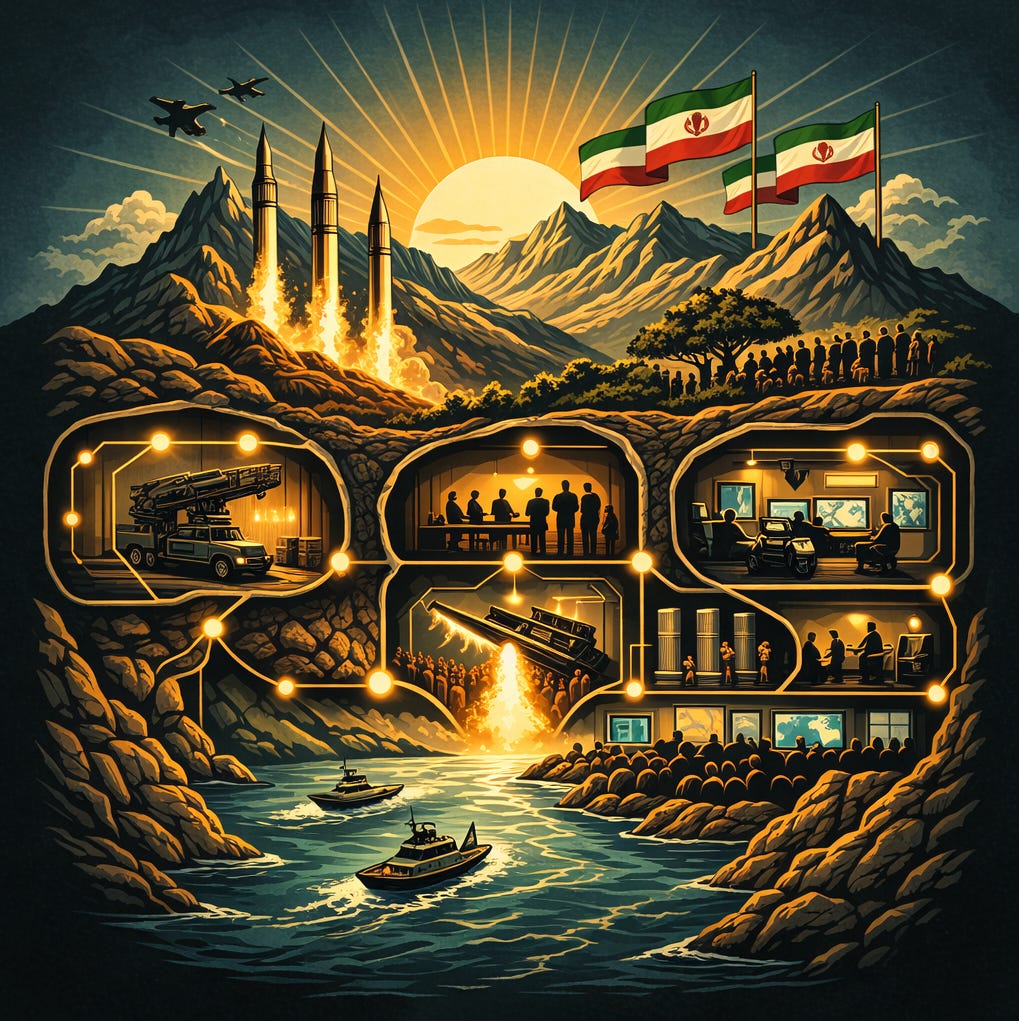
As the war against Iran enters its eleventh day and the Iranian state continues to resist mounting military and economic pressure, it is worth examining the institution at the center of that resilience: the Islamic Revolutionary Guard Corps (IRGC). Often described simply as an elite military force or regime security apparatus, the IRGC is in fact far more complex. Over four decades it has evolved into the core institutional architecture of the Islamic Republic - a hybrid entity combining military power, ideological authority, intelligence capabilities, economic networks and mass social mobilization.
Understanding the IRGC is therefore essential to understanding how the Iranian state functions in war. The Guard was not designed merely to win conventional battles but to ensure the survival of the revolutionary state under conditions of prolonged conflict. Its structure distributes power across specialized forces, embeds loyal networks within society through organizations such as the Basij, and binds its officer corps to the fate of the political system through ideological commitment and material incentives. In this sense, the IRGC operates less like a traditional army and more like a state within the state, tasked above all with preserving the revolutionary order.
This institutional logic also reflects a deeper tradition of Iranian statecraft in which protecting the state and the institutions that defend it has long been seen as central to safeguarding Iran’s sovereignty and civilizational continuity. Examining how the IRGC was constructed - its institutional architecture, recruitment pipelines and ideological filtering mechanisms - helps explain why expectations of elite defection or internal collapse are often misplaced.
Guards of the Political Order
The creation of such institutions is not unique to Iran. Throughout history, states undergoing profound political transformation have established specialized regime-guarding forces separate from conventional militaries. The Praetorian Guard of Imperial Rome, the Janissaries of the Ottoman Empire, and within Iran’s own history, the Qizilbash warriors who consolidated Safavid rule, illustrate this pattern.
These formations typically emerge when a new political order distrusts the existing military establishment or fears that external enemies may exploit internal divisions. Their purpose is therefore not simply national defense but the protection of the governing system itself, binding the survival of the political order to a corps selected for loyalty as much as military capability.
Such institutions reflect a broader principle of statecraft: the recognition that political systems undergoing revolutionary transformation often rely on trusted coercive institutions whose identity and fortunes are inseparable from the survival of the state.
The Birth of the Revolutionary Guard
The IRGC was established in the immediate aftermath of the Islamic Revolution of 1979. The revolutionary coalition that overthrew the regime of Shah Mohammed Reza Pahlavi faced a fundamental dilemma. The existing Iranian military - the Artesh - had been built under the monarchy and staffed by officers trained under the previous establishment. Although many soldiers ultimately accepted the new order, revolutionary leaders did not fully trust the institution that had served the Shah.
Ayatollah Khomeini and his allies therefore moved quickly to create a parallel force composed of revolutionary loyalists. This organization would serve as the armed guardian of the revolution and ensure that the Islamic Republic could defend itself against foreign enemies and internal counterrevolution.
The logic of this institution was explicitly codified in the constitution of the Islamic Republic. Article 150 states that the IRGC, established following the victory of the revolution, is to remain in existence so that it may continue “guarding the Revolution and its achievements.”
This constitutional language revealed a crucial distinction within Iran’s military structure. The regular armed forces were tasked with defending the country’s territorial integrity. The Revolutionary Guard, by contrast, was tasked with defending the political and ideological order created by the revolution itself.
Khomeini repeatedly emphasized this role in his public statements. In a 1980 address reaffirming his support for the Guard, he described the organization as an essential pillar of the new state while insisting that its members maintain discipline and revolutionary commitment. The message was clear: the Guards were to be both shield and enforcer of the Islamic Republic.
The Formative Years of the Iran-Iraq War
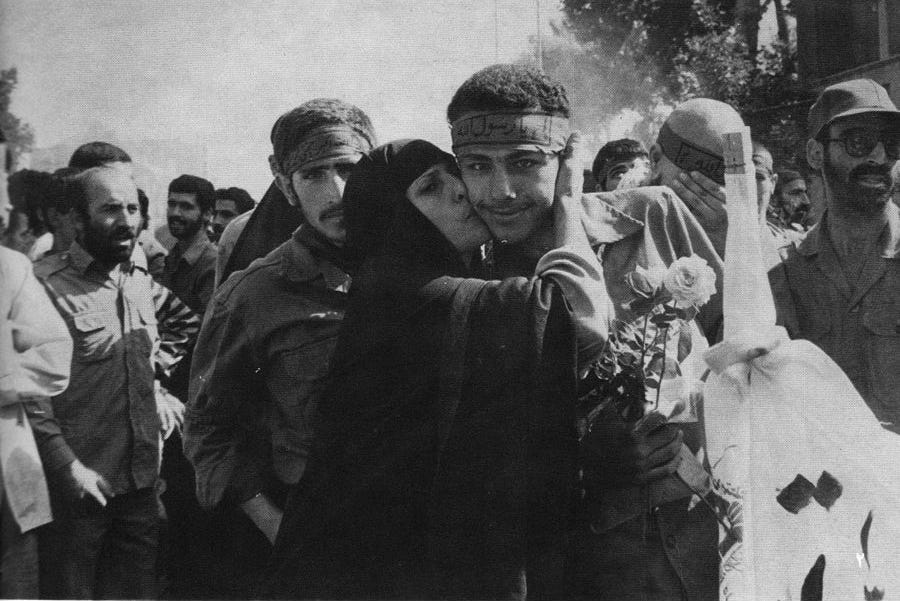
Initially the IRGC was a loose collection of revolutionary militias composed largely of young volunteers with little formal training. The Iraqi invasion of Iran in 1980 transformed the organization almost overnight. Faced with a major conventional war, the Guards rapidly expanded, developed formal command structures and forged the operational doctrines that would define the institution.
By the end of the eight-year conflict, the IRGC had emerged as a battle-hardened military force with its own strategic culture - one shaped by scarcity, mass casualties and constant confrontation with a technologically superior enemy. The war produced a generation of commanders who came of age in the trenches, including figures such as the late General Qassem Soleimani, and who internalized a doctrine centered on endurance, improvisation and asymmetric warfare against more powerful adversaries.
That experience remains foundational to the Guard’s identity which saw the death of over 200,000 soldiers and volunteers. The memory of that war - referred to in Iran as the “Sacred Defense” or دفاع مقدس (Defāʿ-e Moqaddas), - remains deeply embedded in the IRGC’s institutional ethos. Its commanders frequently invoke the “values of the Sacred Defense,” or ارزشهای دفاع مقدس (Arzesh-hā-ye Defāʿ-e Moqaddas) - embodying sacrifice, martyrdom and resilience - as the moral foundation of the force, reinforcing the belief that survival in war depends not only on military capability but on society’s willingness to endure prolonged conflict.
The Institutional Architecture of the IRGC
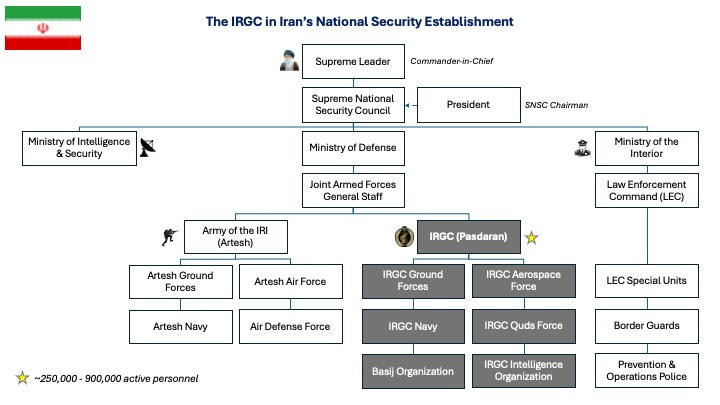
Over time, the IRGC developed a set of specialized branches that operate with significant autonomy while remaining tied to the Supreme Leader as their ultimate authority. Analysts often identify several core pillars within this structure.
The IRGC Ground Forces: Territorial Defense and Asymmetric Warfare
The IRGC Ground Forces (IRGC-GF) are the land-warfare branch of the organization responsible for territorial defense, internal security and irregular warfare across Iran’s provinces. Their functions differ to those of the Artesh Ground Forces, which are structured as a conventional army designed for traditional battlefield operations. The IRGC-GF are estimated to number around 120,000–150,000 personnel, organized into regional commands and supported by hundreds of thousands of Basij auxiliaries who can be mobilized for local defense and insurgent-style resistance.
In the event of a ground invasion of Iran, these forces would focus on decentralized resistance, urban warfare and guerrilla operations, leveraging the Basij’s local networks and Iran’s difficult terrain to stretch supply lines and impose sustained attrition on invading forces.
Rather than attempting to defeat a technologically superior army in open battle, the IRGC-GF are designed to fragment the battlefield into dozens of localized conflicts, turning cities, mountains and infrastructure into a prolonged war of resistance.
The IRGC Navy: Asymmetric Maritime Warfare
The IRGC Navy (IRGC-N) is the organization’s separate maritime arm, numbering about 20,000 personnel. Unlike the Artesh navy, which is a more conventional fleet focused on blue-water operations in the Gulf of Oman and the Indian Ocean, the IRGC-N is built for asymmetric warfare in the Persian Gulf and Strait of Hormuz using fast attack craft, mines, coastal anti-ship missiles, drones and swarm tactics.
At present, the IRGC-N’s role would be to harass and attrit US naval forces, threaten shipping and complicate any amphibious or logistical entry through the Strait of Hormuz, turning the narrow waterway into a dense anti-access battle space.
The IRGC Aerospace Force: Strategic Missiles and Drones
The IRGC Aerospace Force (IRGC-ASF) is the Guard’s missile, drone, air-defense and space arm. Open-source estimates generally place it at roughly 15,000–20,000 personnel. Unlike the Artesh Air Force, which is a more conventional service built around manned combat aircraft and traditional air operations, the IRGC-ASF is centered on strategic deterrence through ballistic missiles, cruise missiles, drones and dispersed launch infrastructure.
In the ongoing conflict, the IRGC-ASF has been one of Iran’s principal strike arms, driving retaliatory missile and drone attacks while also absorbing heavy pressure on its missile launchers, production sites and command infrastructure. Recent reporting and analysis indicate that US and Israeli operations have focused heavily on degrading Iran’s offensive missile capability, while Iranian retaliatory strikes across Israel and the Gulf have relied extensively on the Aerospace Force’s missile-and-drone arsenal.
The Quds Force: Expeditionary and Intelligence Operations
The IRGC Quds Force is the Guard’s external operations and expeditionary arm, estimated in open-source assessments to number around 5,000–10,000 personnel. It manages Iran’s network of allied militias and partners across the Middle East, providing intelligence coordination, training, weapons transfers and strategic planning to groups in Iraq, Syria, Lebanon and Yemen.
The force would be playing a central role in activating and coordinating proxy forces across the region in light of the current war, expanding the conflict horizontally through missile, drone and militia operations in order to impose costs without relying solely on direct confrontation.
The Basij Organization: Mass Mobilization and Social Control
The Basij Resistance Force is the IRGC’s mass mobilization and auxiliary paramilitary network, created during the Iran–Iraq War and embedded across neighborhoods, mosques, schools and workplaces throughout Iran. Open-source estimates vary widely, but analysts generally estimate 90,000-120,000 active members and hundreds of thousands to over a million reservists and volunteers who can be mobilized in crises.
In the event of a ground invasion, the Basij would likely function as the backbone of local resistance and urban defense, supporting IRGC Ground Forces through neighborhood surveillance, militia mobilization, logistics and guerrilla-style warfare designed to turn cities and towns into decentralized zones of prolonged attrition.
The IRGC Intelligence Organization: Internal Security and Counterintelligence
The IRGC Intelligence Organization (IRGC-IO) is the Guard’s internal-security, counterintelligence and domestic intelligence arm, tasked with detecting infiltration, suppressing unrest, monitoring online activity and protecting the state from espionage and “soft war.” Public personnel figures are not reliably disclosed, so unlike the Ground Forces or Navy there is no solid open-source headcount. What is clear is that it sits at the center of the institution’s internal coercive apparatus and has broad reach through Basij intelligence networks across the country.
At present, the IRGC-IO appears to be playing a primarily defensive internal-war role, hunting suspected infiltrators and sabotage cells, mobilizing public reporting of “suspicious” activity, supporting nationwide security checks with the Basij and helping manage the cyber and domestic-security fallout from US and Israeli strikes and related cyberattacks on Iranian infrastructure.
In the early days of the war, American and Israeli strikes reportedly targeted several police stations in Tehran, apparently assuming that degrading local law-enforcement infrastructure could trigger unrest. Yet, most police stations fall under Iran’s Law Enforcement Command (LEC) - the national police under the Ministry of Interior - rather than the IRGC or Basij, which form the state’s core coercive backbone. As a result, such strikes do little to weaken the institutional networks that actually sustain state control.
Khatam al-Anbiya: The Economic Architecture
Another pillar of the IRGC’s influence lies in its economic activities. Khatam al-Anbiya Construction Headquarters, the Guard’s engineering conglomerate, has become one of the largest contractors in Iran, participating in major infrastructure projects including dams, transportation networks, oil and gas development and large-scale urban construction.
Through subsidiaries and affiliated companies, the organization has embedded itself across strategic sectors of the Iranian economy. Western sanctions have inadvertently strengthened this system. As foreign firms withdrew from Iran, IRGC-linked companies increasingly filled the vacuum, expanding the Guard’s economic reach while generating revenue streams and patronage networks that reinforce institutional loyalty.
Over time, this process has produced broader political consequences. The Guard’s expanding role in infrastructure, energy, telecommunications and construction has fostered the emergence of a business elite closely tied to the IRGC. In effect, decades of sanctions have helped create an economic class whose wealth and influence are intertwined with the survival of the Islamic Republic.
Even where corruption or patronage exists within this ecosystem, it also generates a powerful structural incentive for cohesion. Individuals whose fortunes depend on the existing order have little reason to tolerate fragmentation within the Guard or support any rupture that could threaten the system on which their position depends.
Engineering Loyalty: How the IRGC Selects Its Defenders
Why the Institution Rarely Splinters
Understanding how the IRGC recruits and socializes its members is essential for evaluating a central assumption often made in discussions of war with Iran, which is that sustained military pressure could trigger elite defection, internal splintering or a security-force-backed popular uprising. The institutional architecture of the Guard suggests the opposite.
From its inception, the IRGC was designed not as an open national army but as a selective ideological ecosystem in which access to coercive authority follows years of observation, socialization and political vetting. Examining this pipeline helps explain why the organization has historically displayed strong unity, and why external conflict often reinforces rather than weakens that cohesion.
The Long Socialization into the Guard
Recruitment into the Basij - and for a smaller subset into the IRGC - functions less like a single enlistment event and more like a multi-year filtration process beginning in schools and continuing through neighborhood religious institutions.
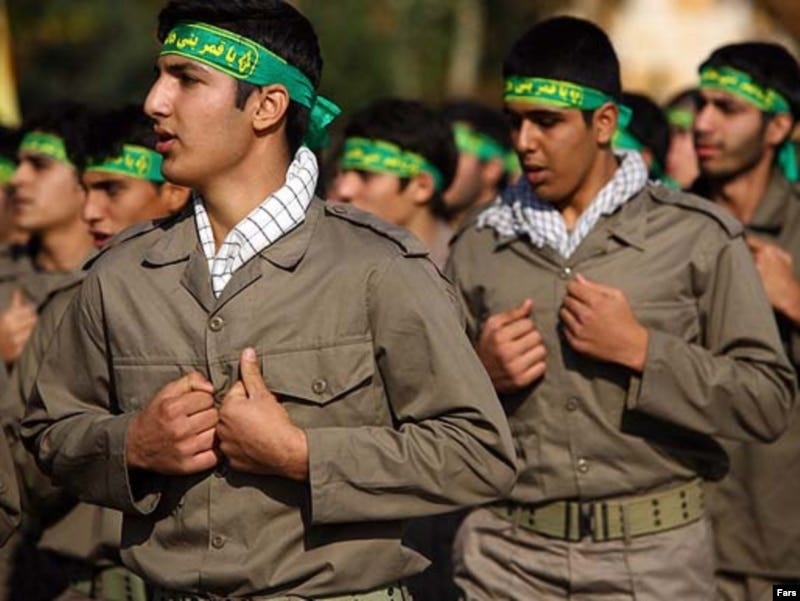
The Student Basij
A key gateway is the Student Basij, which operates within Iran’s educational system in cooperation with the Ministry of Education. It’s school-based branches begin recruiting students as young as twelve, gradually exposing adolescents to the organization’s culture, ideological narratives and social networks well before military age. The Student Basij is similar to the "young pioneers" and Komsomol in the former Soviet Union. In other words, they constitute a mass youth movement that helps to encourage state support from an early age.
Neighborhood Screening
At the level of the neighborhood or محله (mahalleh), recruitment is tied to mosque-centered Basij units supervised by local clerics and trusted community figures. These networks serve not only as mobilization structures but also as screening mechanisms. Participation, family background, religious practice and political attitudes can be observed over extended periods within the same local community. A single mahalleh may contain multiple Basij bases. In 2015, Tehran’s Basij commander Mohammed Reza Naqdi noted that roughly 2,000 Basij bases operated across 375 mahalleh in the capital.
Tiered Basij Membership
Membership itself is tiered starting with regular members, then active members and finally special members - with each stage involving deeper participation and ideological training. Special members often hold paid positions and operate in closer coordination with IRGC units, creating a structural bridge between the Basij and the Guard.
Ideological Vetting as Institutional Safeguard
Ideological formation is reinforced through structured training programs, including study circles, mosque-based discussion groups and initiatives such as the Salehin Plan or شجره طیبه صالحین (Shajareh Tayyebeh Salehin), which aim to strengthen loyalty to the Islamic Republic and the doctrine of “Guardianship of the Islamic Jurist” or ولایت فقیه (velāyat-e faqīh) - the principle that political authority should ultimately rest with a senior Islamic jurist who safeguards the state’s conformity with Islamic law - while preparing members to confront what Iranian officials describe as “soft war”.
Within the IRGC itself, ideological oversight is embedded directly in the command system through the Office of the Supreme Leader’s Representative in the IRGC. Clerical representatives operate alongside military commanders at every level, monitoring ideological alignment and overseeing political training.
Personnel screening also occurs through Iran’s broader gozinesh system, which evaluates political beliefs, religious commitment and loyalty to the Islamic Republic through background investigations involving local community networks and officials.
The Result: A Long-Horizon Filter
Taken together, these mechanisms form a long-horizon sociological filter. Individuals who eventually enter the IRGC’s ranks have often spent years within overlapping networks of schools, mosques, Basij units and ideological training programs.
The result is an institution whose core personnel are selected not only for competence but for sustained ideological reliability. Members of the Guard are therefore not simply professional soldiers whose allegiance may shift with political circumstances. Their identities, careers and institutional status are deeply tied to the survival of the revolutionary state.
For this reason, external conflict often has the opposite effect from what outside observers expect. Rather than fragmenting the institution, confrontation with external adversaries tends to reinforce the narratives and loyalties that sustain the IRGC’s cohesion.
Another often overlooked feature of the IRGC is its institutional depth. The organization is not structured around a handful of irreplaceable personalities but around layered command networks capable of absorbing leadership losses. This was visible after the June 2025 war, when senior commanders killed in Israeli strikes were rapidly replaced by the next echelon, underscoring that the Guard’s continuity rests less on individual figures than on a deeply entrenched system of succession, ideological screening and organizational redundancy.
Material Incentives and Institutional Loyalty
Ideology alone does not explain the IRGC’s cohesion. Material incentives also play a role. Over decades, the Guard has built extensive economic networks that provide employment, contracts and business opportunities to members and their associates. This system creates powerful incentives for maintaining the status quo.
The personal fortunes of many individuals within the IRGC ecosystem are tied to the survival of the political system. In the event of regime collapse, these networks would likely dissolve. As a result, loyalty to the system often reflects both ideological commitment and institutional self-interest.
Implications for an Invading Force
If the Trump administration is considering options for a ground invasion to engineer state collapse, the implications are stark. An invading force would confront not simply an army but an institution embedded deeply within the political, economic and social fabric of the state. The challenge would therefore extend far beyond defeating organized military units on the battlefield. Even if conventional formations were degraded, the broader institutional ecosystem surrounding the IRGC would continue to provide the state with mechanisms for coordination, resource mobilization and political control.
In such a scenario, the central problem for an invading force would not be initial military entry but the difficulty of translating battlefield success into political collapse. An adversary confronting an institution designed for continuity under pressure would face a prolonged struggle. The decisive question becomes not how quickly territory can be seized, but whether the intervening power possesses the time, resources and domestic tolerance required to sustain a long campaign against a system built to endure it.
The Architecture of State Survival
Four decades after the Iranian Revolution, the IRGC has evolved into one of the most sophisticated state-security institutions in the modern world. Its power derives not from a single source but from the interaction of several systems: specialized military branches capable of asymmetric warfare, a mass mobilization network embedded in society and extensive economic enterprises that bind the organization to the state.
Equally important is the Guard’s ideological identity, shaped by the historical memory of the Iran–Iraq War and sustained through political education and internal vetting. Together, these elements form an architecture designed to ensure state survival under conditions of extreme pressure.
Any attempt to understand Iran’s strategic resilience must therefore confront a central reality: the IRGC is not merely a military force. It is the institutional backbone of a political system designed, above all, to survive war.
If you’ve found this analysis valuable, please consider becoming a free or paid subscriber. Your support directly enables me to devote more time to deep research and long-form writing of this kind, free from algorithms and click-driven incentives.
References:
Katzman, Kenneth., “The Islamic Revolutionary Guard Corps (IRGC): Organization and Role in Iran”, Congressional Research Services (CRS), various editions.
Osotvar, Afshon., “Vanguard of the Imam: Religion, Politics, and Iran’s Revolutionary Guards”, Oxford University Press, 2016.
Wehrey, Frederic et al., “The Rise of the Pasdaran: Assessing the Domestic Roles of Iran’s Islamic Revolutionary Guard Corps”, RAND Corporation, 2009.
Abrahamian, Ervand., “A History of Modern Iran”, Cambridge University Press, 2008.
Harris, Kevan., “A Social Revolution: Politics and the Welfare State in Iran”, University of California Press, 2017.
Mavani, Hamid., “Religious Authority and Political Thought in Twelver Shi’ism”, Routeledge, 2013.
Arjomand, Said Amir., “The Constitution of the Islamic Republic”
US Defense Intelligence Agency, “Iran Military Power: Ensuring Regime Survival and Securing Regional Dominance”, 2019.
Cordesman, Anthony H., “Iran’s Military Forces and Warfighting Capabilities”, Center for Strategic and International Studies (CSIS), September 25, 2007.
Congressional Research Service reports on Iranian military forces.
US Institute of Peace, “The Iran Primer”
Khomeini, Ruhollah., “Islamic Government (Hokoumat-e Islami)”, 1970 lectures.
Maloney, Suzanne., “Iran’s Political Economy since the Revolution”, Cambridge University Press, 2015.
Golkar, Saeid., “Captive Society: The Basij Militia and Social Control in Iran”, Columbia University Press, 2015.
Tehran Basij commander Mohammad Reza Naqdi statements (reported in Iranian media and academic analyses)
A much needed explanation. Very much illuminating.
Incredibly informative article, thank you!