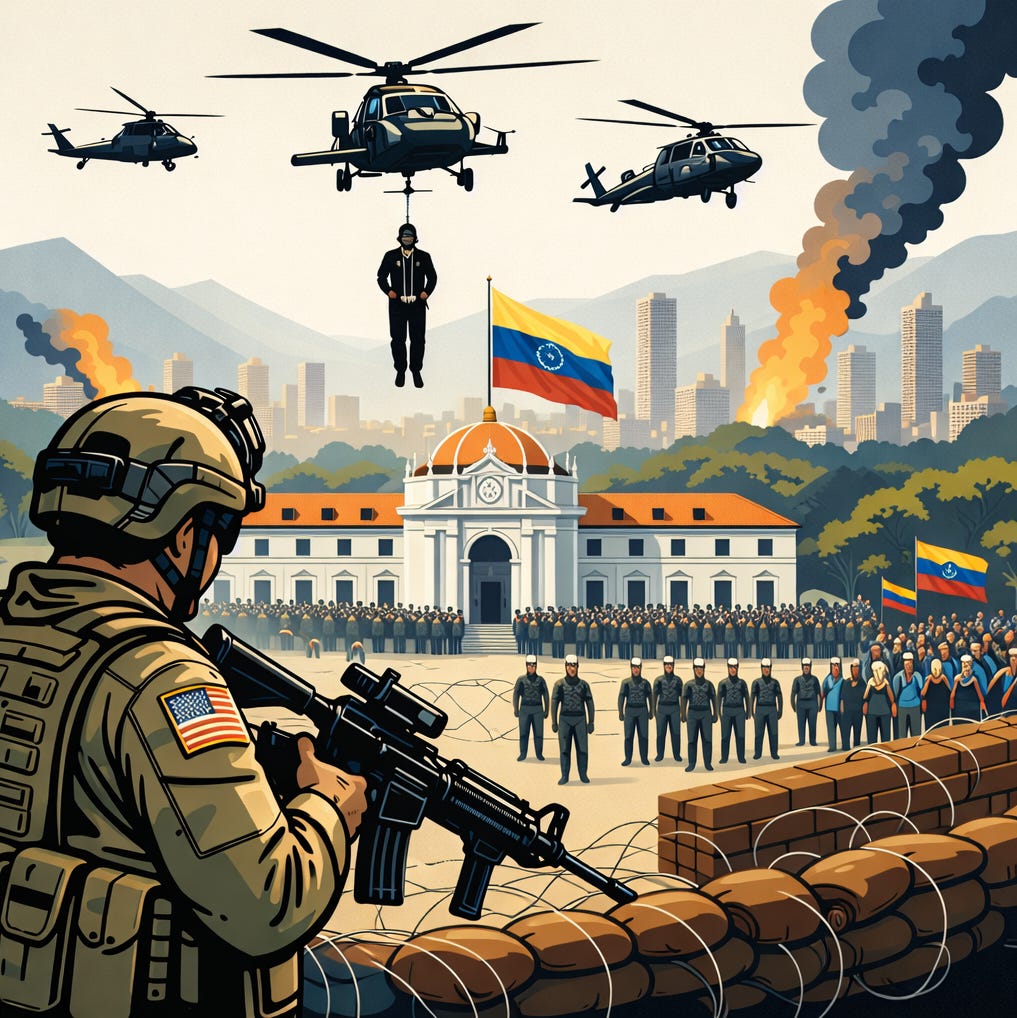
Decapitation Without Destruction: Why the Abduction of President Maduro Creates a Strategic Crisis for the United States
Seizing Nicolás Maduro may have been tactically clean, but it has created a legitimacy crisis likely to draw Washington into prolonged resistance and strategic overreach rather than decisive control.
As the euphoria in the US mainstream media begins to settle over the dramatic events in Venezuela over the last twenty-four hours, a more sober strategic assessment is required. The US military operation that seized Venezuelan President Nicolás Maduro and transported him to the United States has been widely portrayed as a decisive and clean assertion of American power. In fact, it represents one of the most radical assertions of imperial authority in the Western Hemisphere since the Cold War.
Yet, beneath the celebratory headlines lies a far more complex reality. While the operation succeeded tactically, it did not dismantle the Venezuelan state. Ministries remain staffed, the armed forces remain cohesive, the judiciary and bureaucracy continue to function and the governing party is still operational. Vice President Delcy Rodriguez has now been declared interim president by the country’s Supreme Court. This sharply distinguishes Venezuela from Afghanistan (2001), Iraq (2003), or Libya (2011), where the destruction or hollowing-out of institutions was the primary driver of chaos.
Paradoxically, this distinction does not make the US position safer. In many respects, it makes it more dangerous. What Washington has executed is not regime change by demolition, but sovereignty removal by decapitation through the forcible extraction of a sitting head of state while leaving the governing machinery intact (at least for now) but politically poisoned.
History shows that this model produces a different, though no less severe, form of instability - a legitimacy crisis inside a functioning state, where institutions continue to operate procedurally while refusing to internalize the authority of an external power claiming oversight. In such cases, the problem is not capacity or order, but consent. It is precisely this deficit that tends to entangle outside powers far longer than anticipated.
The Core Error: Confusing Institutional Continuity With Political Control
While it is still early to gauge how US strategy will unfold in the coming weeks and months, the assumption appears to be that because Venezuelan institutions remain intact, governance can proceed smoothly under a transitional arrangement that is blessed or supervised by Washington. This is a profound misreading of how authority works.
Institutions do not obey structures. They obey sources of legitimacy. Bureaucracies, courts, armed forces and security services may continue to function procedurally while withholding genuine political obedience from imposed authority. This produces paralysis, quiet sabotage, selective compliance and eventually resistance.
The United States is not facing a collapsed state in Venezuela. It is facing a state that still exists but may not recognize Washington’s right to arbitrate its political future.
Historical Analogues: Leader Removal Without State Collapse
To understand the likely trajectory, it is worth examining cases where leaders were removed or seized by external force while the state apparatus survived.
Panama (1989): The Noriega Precedent
The closest Western Hemisphere analogue is the US capture of Manuel Noriega in 1989. Noriega was seized and taken to the United States to face trial, while Panama’s institutions were left standing. However, the key difference is scale and context. Panama was a small state with a limited military, overwhelming US force on the ground and a population that did not view Noriega as a national symbol of sovereignty.
Even under these favorable conditions, Panama required direct US military occupation to stabilize the situation. Authority was enforced, not assumed. In Venezuela, by contrast, the armed forces are far larger and more politicized, nationalist sentiment is significantly higher and no comparable US troop presence exists yet to impose order. If Panama required occupation to make decapitation work, Venezuela will unlikely submit to administration at arm’s length.
Haiti (1994 and 2004): Aristide and the Legitimacy Trap
The US-backed removal of Jean-Bertrand Aristide - twice - offers another instructive case. In both instances, Haitian state institutions remained nominally intact. Ministries, police and courts did not disappear. Yet, Haiti entered prolonged instability because no political settlement commanded legitimacy across society. The externally-shaped transitions were seen as imposed, not consensual. The result was chronic unrest, factional violence and long-term dependency on foreign security assistance. Venezuela’s institutions are stronger than Haiti’s, but so is Venezuelan resistance to foreign tutelage.
Honduras (2009): Institutional Survival, Political Rupture
The removal of Manuel Zelaya did not destroy Honduras’s institutions. Congress, courts and the military all remained operational. What followed was not state collapse but years of political illegitimacy, social polarization and endemic violence. Elections proceeded, but under a cloud of external pressure and internal distrust that permanently weakened governance. This is a critical warning that institutions can survive while political cohesion dies.
Iran (1953): The Long Tail of Decapitation
The CIA and MI6-backed removal of Mohammad Mossadegh left Iran’s state intact and functioning. The Shah ruled with full institutional continuity. Yet, the legitimacy rupture created in 1953 festered for a generation, culminating in the 1979 revolution that permanently severed US-Iranian relations. The Iranian state did not collapse in 1953, but the memory of external interference reshaped its political identity forever. Venezuela will likely follow a similar path with institutional continuity in the short term but strategic hostility in the long term.
Why Venezuela is Especially Resistant to External Custodianship
Three structural factors make Venezuela uniquely hostile to the model Washington appears to be attempting. The first concerns a politicized and nationalized military. Venezuela’s armed forces are not neutral technocrats. They are ideologically conditioned around sovereignty, anti-imperialism and national control of resources. Removing Maduro does not neutralize this worldview, but intensifies it. An externally supervised transition threatens the military’s self-conception as the guardian of the republic. That makes quiet resistance more likely than open mutiny and far harder to defeat.
It must be noted here that the fact that US helicopters entered Caracas, seized Maduro and exited without any significant resistance does not demonstrate Venezuelan military acquiescence or institutional weakness. It more plausibly reflects temporary denial of response at the apex of command - confusion, withheld authorization, selective stand-downs by a narrow set of gatekeepers or deliberate restraint to avoid catastrophic escalation against overwhelming US force. Modern, politicized militaries do not automatically fire under conditions of uncertainty. They calculate institutional survival. Thus, if inducements or coercion occurred, they needed only to neutralize air-defense commanders and presidential guard leadership, not the entire force. A clean extraction therefore signals elite fracture and risk aversion in the moment, not acceptance of foreign custodianship. Indeed, militaries humiliated without being destroyed often shift toward delayed, asymmetric and deniable resistance, making the absence of immediate kinetic response a warning sign rather than reassurance for Washington.
Second, years of sanctions have already framed Venezuelan politics as a siege narrative. The abduction of a president by foreign troops validates that narrative overnight. This does not require mass Chavista loyalty. It only requires national pride, which is now directly implicated.
Third, appointing Secretary of State Marco Rubio and Secretary of War Pete Hegseth to exercise oversight or custodial authority over the country, even if temporarily, expose the central contradiction that authority without coercive presence is symbolic, not real. Unless the United States is prepared to deploy and sustain large forces on Venezuelan soil, something it has conspicuously avoided given the drain that it would put on human and economic resources, it cannot enforce decisions, protect collaborators or manage unrest. This produces the worst of both worlds in the form of responsibility without control, influence without legitimacy and accountability without trajectory.
The Likely Trajectory: Institutional Continuity, Political Resistance
The future of Venezuela will likely resemble a functioning but defiant state, a country that will be governed by institutions that comply procedurally but resist substantively, a society facing rising unrest, selective non-cooperation and nationalist mobilization. This is a slow-burn crisis, not an immediate collapse. For the United States, this is more dangerous than chaos. The latter invites exit. Legitimacy crises invite entanglement.
By declaring responsibility for Venezuela’s transition, Washington implicitly assumes responsibility for security, economic stabilization and political outcomes. Any unrest will demand intervention; any failure will demand escalation. Over time, this risks drawing the United States into prolonged spending, political ownership of outcomes it cannot control and credibility traps it cannot easily exit.
Crucially, this commitment comes as US financial and military resources are already under strain, with rising debt, persistent inflationary pressures, domestic infrastructure decay and an overstretched force posture shaped by simultaneous commitments in Europe, the Middle East and the Indo-Pacific. Venezuela thus risks becoming not a contained intervention, but an additional drain on American fiscal capacity and strategic attention at a moment when domestic economic resilience and public tolerance for open-ended foreign entanglements is steadily eroding.
Decapitation is not Neutralization
The abduction of President Maduro did not destroy the Venezuelan state. It did something more corrosive by severing the legitimacy link between Venezuelan institutions and any externally-imposed authority.
History shows that when sovereignty is violated without total occupation, states do not submit. They adapt, resist quietly, indirectly and over time. What appears today as decisive action may soon reveal itself as strategic exposure. The United States may soon discover that it is far easier to seize a president than to govern a large, complex nation that does not recognize its authority.
If you’ve enjoyed this analysis, I’d love to welcome you as a subscriber. It’s free, and you’ll get every new essay delivered directly to your inbox. No algorithms, just thoughtful writing.


"Custody" is what a parent has, and it has warm and fuzzy connotations. Therefore I suggest that instead of "custodianship" you substitute the word "dictatorship," which more accurately depicts what is happening, and frankly, I hope the Venezuelans put up a hell of a lot better showing than you imply. There is no "legitimacy crisis" because there is utterly no legitimacy to what has occurred or the American attempted dictatorship. One could even hope that the barbarity of this particular exercise in scorn for all that is decent and right will provoke internal unrest within the States. I guess it's too much to hope for that China or Russia would step in to help. Maybe the Yemenis, who seem to be the only principled nation in existence at the moment, will take action.
Kautilya, since you are well versed in lateral thinking, and looking from a different perspective, I would be interested to hear your take on what the trigger point for launching the operation at this time was.