Why Russia Never Stops Negotiating: A Millennium of Strategic Statecraft
Russia's repeated return to diplomacy reflects not optimism or trust, but a centuries-old strategy of preserving, recovering and expanding state power under conditions of enduring geopolitical rivalry

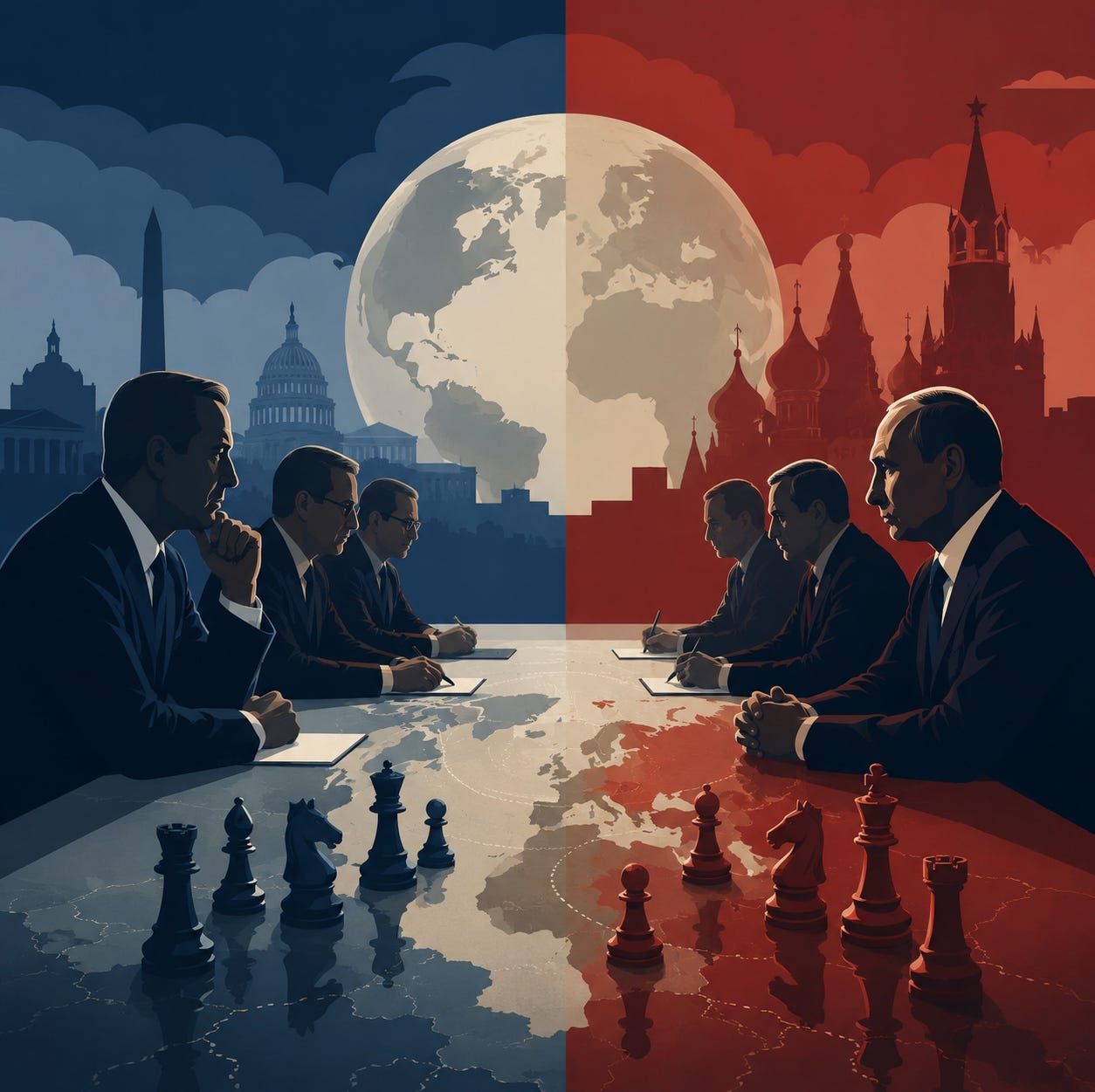
Prelude to a four-part essay series
The Question History Rarely Asks
History is replete with studies of failed diplomacy. Questions are asked as to why negotiations collapse, why treaties are violated, why wars erupt despite countless conferences and summit meetings. Yet one of the most revealing questions is rarely asked: why do states continue negotiating after diplomacy appears to have failed?
Few countries illustrate this puzzle more clearly than Russia. Since the end of the Cold War, Moscow has participated in an extraordinary succession of diplomatic initiatives that ultimately failed to prevent confrontation with the West. From Kosovo and the expansion of NATO, to Libya, the Minsk Agreements, the Normandy Format, the draft security treaties of December 2021 and the negotiations surrounding Ukraine, Russian diplomacy repeatedly returned to the negotiating table despite mounting evidence that previous agreements had not produced the security order Moscow sought.
Among critics in alternative media and independent geopolitical commentary, the persistence by President Vladimir Putin to continue negotiating on Ukraine has often been interpreted as a sign of excessive patience or even naivety. Many argue that the United States and its European allies have repeatedly demonstrated themselves to be incapable of sustaining durable agreements with Russia.
The Minsk Agreements are frequently cited as the clearest example of this criticism. If successive agreements were ignored, circumvented or openly violated, why repeatedly invest political capital in diplomatic processes that ultimately bought time for the West, consolidated NATO's position or postponed rather than resolved underlying conflicts?
The answer, I suggest, lies in a misunderstanding of Russian strategic thought itself. The question assumes that Moscow approaches diplomacy primarily as a search for trust or reconciliation. Yet viewed across more than a thousand years of Russian history, diplomacy has rarely served that purpose. Rather, it has functioned as one of the principal instruments through which Russian rulers have preserved the state during periods of weakness, restored national power after strategic setbacks and shaped the geopolitical environment in which military force might eventually be employed.
This distinction forms the foundation of the essays that follow. They do not seek to determine who was morally right or wrong in the disputes between Russia and the West. Nor are they primarily an account of broken promises or diplomatic betrayals. They do not ask whether Russia trusted the West. They ask a different question: whether Moscow gradually lost confidence that diplomacy alone could still produce a durable European security order.
To answer that question, one must first understand what diplomacy has historically meant in the Russian strategic tradition.
Diplomacy Was Never About Trust
Since the ancient world, the greatest theorists of statecraft have understood diplomacy not as a mechanism for eliminating conflict but as a means of managing it. Although they wrote in different civilizations and historical eras, they shared a common assumption: states pursue interests in an environment of enduring uncertainty, where cooperation is always conditional and trust is never sufficient to guarantee security.
Thucydides observed that negotiations occurred not because rival powers trusted one another but because they sought to reconcile fear, interest and necessity. His account of the Peloponnesian War depicts diplomacy as an instrument through which competing powers sought temporary accommodation while continuing to prepare for future rivalry. Conflict and negotiation were not opposites but parallel features of interstate relations.
Kautilya developed this logic even further in the Arthashastra. Treaties (sandhi) were not moral commitments but strategic instruments whose value depended upon the prevailing balance of power. A ruler should make peace when it advanced the interests of the state and abandon it when circumstances fundamentally changed. Kautilya’s famous mandala theory likewise assumed that today’s ally could become tomorrow’s adversary, and vice versa, making permanent friendships impossible. Diplomacy required constant reassessment of relative power, intentions and advantage rather than confidence in another ruler’s goodwill.
Centuries later, Prince Metternich sought to preserve peace in Europe not by eliminating rivalry among the great powers but by embedding it within a stable balance of power known as the Concert of Europe after 1815. The famous American diplomat George F. Kennan likewise maintained that international politics was defined by enduring competition rather than the expectation of lasting harmony. Neither believed that diplomacy could abolish geopolitical rivalry; its purpose was to regulate rivalry before it became catastrophic.
Across centuries and civilizations, these thinkers shared a remarkably consistent premise. Diplomacy does not eliminate distrust. It manages relations despite distrust. Russian strategic thought developed within precisely this realist tradition.
The Russian Strategic Mind
Russian diplomacy has never been the product of a single ruler, ideology or historical period. Across more than a thousand years, statesmen operating under vastly different geopolitical circumstances repeatedly adapted the same strategic principles to changing realities. Whether governing the principalities of medieval Rus’, the Russian Empire, the Soviet Union or the Russian Federation, they consistently treated diplomacy not as an alternative to power but as one of its principal instruments.
Russia’s geography helps explain why. Unlike most European powers, Russia developed as a vast continental civilization spanning multiple cultural, religious and geopolitical frontiers. Political scientist Sergey Medvedev has described it as a “poly-periphery” - a state situated at the intersection of several civilizational worlds rather than anchored to a single one. Throughout its history, Russia has simultaneously confronted Europe, the Eurasian steppe, the Islamic world, Central Asia and East Asia, while many of the peoples within the Russian state maintained historical, linguistic and religious ties extending beyond its borders. Geography therefore made diplomacy not merely a foreign policy instrument but a prerequisite for governing a continental empire. Unlike maritime powers, Russia could rarely afford to neglect one frontier without creating vulnerability on another.
A Diplomacy of Time
Viewed across the centuries, Russian diplomacy emerges as something more fundamental than a technique of negotiation. It is, above all, a diplomacy of time. Again and again, negotiation was used to create the one strategic resource that Russia's rulers repeatedly required most: time - time to preserve the state, recover from defeat, rebuild national power, test the intentions of rivals and shape more favorable geopolitical conditions.
This understanding helps explain why Russian diplomacy has repeatedly exhibited several distinctive characteristics. It seeks to preserve the state before seeking advantage. It places unusual emphasis on formal written agreements, treaties and documentary records that establish legal and historical evidence for future generations. It allows diplomacy and military preparation to proceed simultaneously rather than sequentially. Above all, it aims to shape the strategic environment long before military force becomes necessary.
Within this tradition, diplomacy is rarely abandoned simply because trust has disappeared or agreements have been violated. It ends only when Russian leaders conclude that negotiations can no longer alter the strategic balance, preserve the state's long-term interests or create the strategic time necessary for national recovery. The decisive question is therefore not whether diplomacy has failed, but whether it still retains strategic utility.
A Millennium of Strategic Continuity
One of the most remarkable features of Russian diplomatic history is that Russia has often negotiated most intensively after its greatest geopolitical setbacks. Defeat did not diminish the importance of diplomacy; it elevated it. From Alexander Nevsky’s accommodation with the Golden Horde, through Gorchakov’s patient revision of the Crimean settlement, to Primakov’s diplomacy after the collapse of the Soviet Union, negotiation repeatedly became the instrument through which Russia preserved the state, created the strategic time necessary for national recovery and eventually restored its position.
The episodes that follow illustrate this remarkable continuity.
Preserving the State
Alexander Nevsky (13th Century)
The pattern first emerges with Alexander Nevsky in the 13th century. Confronted simultaneously by Mongol domination from the east and military pressure from the Teutonic Knights in the west, Nevsky chose accommodation with the Golden Horde while resisting western invasion. His diplomacy has often been portrayed as submission. In reality, it purchased the strategic time on which the survival of the Russian state depended.
Recovering Great Power Status
Alexander Gorchakov (1856-1882)
The same logic reappeared after the Crimean War. Rather than seeking immediate military revanche following Russia's defeat, Foreign Minister Alexander Gorchakov embarked upon one of the most patient diplomatic campaigns in Russian history. His famous declaration that "Russia is not sulking; Russia is concentrating" captured a strategic philosophy that reached far beyond 19th-century Europe. Over the next fifteen years, Russia steadily dismantled the restrictions imposed by the Treaty of Paris in 1856, culminating in the London Conference of 1871. His diplomacy had bought Russia fifteen years to concentrate, recover and eventually revise the post-Crimean settlement on far more favorable terms.
Buying Strategic Time
Maxim Litvinov (1930-1939) and Vyacheslav Molotov (1939-1949, 1953-1956)
The interwar period demonstrated the same strategic logic under radically different circumstances. During the 1930s, Foreign Minister Maxim Litvinov sought to buy time by constructing a system of collective security with Britain, France and Poland to deter Nazi aggression.
When those efforts collapsed, Stalin turned instead to the Molotov–Ribbentrop Pact of 1939. While later remembered primarily for its secret protocols, the agreement also reflected a hard strategic calculation: Stalin increasingly treated war with Germany as likely, if not ultimately unavoidable. He believed the Soviet Union needed additional time to rearm, modernize the Red Army and prepare for the conflict he considered inevitable. Diplomacy once again became an instrument for buying strategic time.
Managing Strategic Rivalry
Andrei Gromyko (1957-1985)
The Cold War demonstrated the same logic under nuclear conditions. The Soviet Union entered arms-control negotiations not because it expected rivalry with the United States to disappear, but because rivalry between nuclear superpowers had to be regulated before it became catastrophic. Agreements such as SALT I, the Nuclear Non-Proliferation Treaty and the Helsinki Final Act did not create trust; they stabilized competition, reduced the risk of miscalculation and bought strategic time. As Andrei Gromyko famously observed,
"Better ten years of negotiations than one day of war."
Building a Multipolar Order
Yevgeny Primakov (1996-1999)
The collapse of the Soviet Union confronted Russia with its greatest geopolitical contraction in modern history. Under Yevgeny Primakov, diplomacy once again became Russia's principal instrument of strategic recovery. Unable to reverse Russia's decline through military power alone, Primakov sought first to reshape the international balance through diplomacy. His decision to turn his aircraft back to Moscow after NATO began bombing Yugoslavia in March 1999 symbolized a broader strategic conviction: diplomacy could buy the time necessary for Russia's recovery long before it could restore its power.
Seeking a New Security Architecture
Sergey Lavrov (2004-Present)
As Russia's material capabilities recovered, Foreign Minister Sergey Lavrov carried this tradition into the 21st century. He deepened Russia's strategic partnership with China, helped transform BRICS and the Shanghai Cooperation Organization (SCO) into increasingly influential diplomatic forums, opposed NATO's continued enlargement and repeatedly sought negotiated frameworks for European security through the NATO-Russia Council, the Minsk process and, ultimately, the draft security treaties presented to the United States and NATO in December 2021.
These initiatives differed in context but shared a common objective: establishing mutually accepted rules through which strategic competition could be managed before confrontation became unavoidable. Whether these initiatives succeeded is less important than what they reveal. Russia continued negotiating until it concluded that diplomacy could no longer reshape the European security order on terms compatible with its long-term interests.
Seen together, these episodes reveal a remarkable continuity across more than a millennium. The methods evolved, the adversaries changed and the international system was repeatedly transformed. Yet the underlying logic remained strikingly consistent. Russian diplomacy was never fundamentally an expression of trust or optimism. It was a permanent instrument of statecraft through which successive governments sought to buy time to preserve the state, recover power after strategic setbacks, regulate geopolitical competition and create the strategic time necessary to shape history on more favorable terms.
The Legalistic Tradition
One of the most enduring features of Russian diplomacy has been its distinctly legalistic character. From the treaties concluded with Byzantium in 911, through the Treaty of Nerchinsk (1689), the Treaty of Paris (1856), the Helsinki Final Act (1975), the Minsk Agreements (2014–2015) and Russia’s draft security treaties of December 2021, Moscow has repeatedly sought to transform political understandings into formal written obligations.
In the Russian diplomatic tradition, treaties were never merely instruments of agreement. They preserved political claims across time. Even when governments changed or agreements collapsed, the written record endured as legal evidence against which subsequent conduct could be judged and competing historical narratives contested. Diplomacy therefore sought not only to secure agreement, but to establish an enduring documentary foundation for future statecraft.
Viewed through this lens, Russia’s draft security treaties of December 2021 appear less as an isolated diplomatic initiative than as the latest expression of a millennium-old strategic tradition. Whether accepted or rejected, they created a permanent record of Russia’s proposed security order and the responses it received.
The Road to Ukraine
Understanding Russian diplomacy as an instrument of state preservation rather than an expression of trust fundamentally changes how one interprets Russia’s post-Cold War relationship with the West.
Conventional accounts often treat NATO enlargement, Kosovo, Libya, Georgia, the Minsk Agreements and Ukraine as separate crises, each explained by its own personalities or immediate political circumstances. From Moscow’s perspective, however, they formed a single diplomatic continuum: successive attempts to reconcile Russia’s security interests with a European order increasingly shaped by Western institutions and military power. Each episode became another test of whether negotiated agreements and legal commitments still possessed meaningful political value.
This is the central argument of the essays that follow. They are not primarily about the collapse of individual agreements, but about the gradual erosion of Moscow’s confidence that diplomacy alone could still sustain a durable European security order.
Kosovo marked the first major rupture. Libya deepened Russian doubts about the interpretation of negotiated mandates. The Minsk Agreements further undermined confidence that diplomatic settlements could survive geopolitical competition. Finally, the draft security treaties of December 2021 represented Russia’s most comprehensive attempt to establish a new written framework for European security before the outbreak of war.
Seen together, these episodes reveal not four isolated crises but four chapters in a single historical process. They explain why one of history's most persistent diplomatic powers ultimately concluded that diplomacy remained indispensable, but was no longer sufficient.
Kautilya The Contemplator is a reader-supported publication. To receive new posts and support my work, please consider becoming a free or paid subscriber. I will always be grateful for your support.
References:
Carr, E. H. “The Twenty Years' Crisis, 1919–1939: An Introduction to the Study of International Relations”. 2nd ed. London: Macmillan, 1946.
Gaddis, John Lewis. “The Cold War: A New History”, New York: Penguin Press, 2005.
Gromyko, Andrei. “Memoirs”, New York: Doubleday, 1989.
Medvedev, Sergei. “Rossiya: Prostranstvo kak Faktor Politiki”. Moscow: Gnosis, 1999.
Kissinger, Henry. “A World Restored: Metternich, Castlereagh and the Problems of Peace, 1812–1822”, Boston: Houghton Mifflin, 1957.
Kissinger, Henry. “Diplomacy”, New York: Simon & Schuster, 1994.
Morgenthau, Hans J., “Politics Among Nations: The Struggle for Power and Peace”, 7th ed. New York: McGraw-Hill, 2006.
Primakov, Yevgeny., “A World Challenged: Fighting Terrorism in the Twenty-First Century”, Washington, DC: Brookings Institution Press, 2004.
Riasanovsky, Nicholas V., and Mark D. Steinberg., “A History of Russia”, 9th ed. New York: Oxford University Press, 2018.
Tsygankov, Andrei P., “Russia's Foreign Policy: Change and Continuity in National Identity”, 6th ed. Lanham, MD: Rowman & Littlefield, 2022.
Lieven, Dominic, “Russia Against Napoleon: The Battle for Europe, 1807–1814”, London: Allen Lane, 2009.
Kennan, George F., “American Diplomacy, 1900–1950”., Chicago: University of Chicago Press, 1951.
When I read the comments after this fine and insightful vangaurd missive of a four part series i anticipate with relish, I find myself confused by the stubborn and ongoing lack of comprehension i detect therein as to the entire point of what the writer is actually expounding and verifying through objective historical fact.
At further risk of leaving their understanding adrift in the shoals of their own frustration and confusion as to why the Russians play this longest of games, I'll employ Katilya's own words and ask that they are read more carefully:
"The answer, I suggest, lies in a misunderstanding of Russian strategic thought itself. The question assumes that Moscow approaches diplomacy primarily as a search for trust or reconciliation. Yet viewed across more than a thousand years of Russian history, diplomacy has rarely served that purpose. Rather, it has functioned as one of the principal instruments through which Russian rulers have preserved the state during periods of weakness, restored national power after strategic setbacks and shaped the geopolitical environment in which military force might eventually be employed."
Is Russia's own long-suffering and excruciatingly patient history of diplomacy and negotiation which had unequivically furnished a noble and epic 1000+ years history in the face of such extraordinary and often pernicious geopolitical, social, political and demographic challenges not in itself empirical proof of its efficacy?
Who cares if Putin chooses to meet Witkoff and take measure of him, in the fullness of time? What real matter is it that sidebar issues such as Syria and Kosovo sway to and fro on the Grand Chessboard, if Russia's core interests are preserved and even strengthened in the real politic?
And yes, you can bloviate at length about garden variety, day to day 'failures' that Russia may encounter in its fascinating struggle to fashion and maintain its own, sovereign civilization but they are small things in the context of a dazzling 1000 year odyssey and Russia will endure.
I've never faulted Russia for negotiating, but I do fault Putin for spending so many hours with a couple of grifters under the pretense of negotiations. That sent a strong negative message about Putin's confidence and Russian strength, a message he has consistently reinforced, disastrously.
I think you pointed out that diplomacy could be conducted at the same time kinetic actions were happening, and in that connection you say that Russian diplomacy has often served to buy Russia time to recuperate. I think that might be contradictory, but in any event one should also consider whether Russia is the one losing by the passage of time, which I believe is distinctly the case as regards Ukraine. A country that has so often bought time should have recognized when that was happening to it, and it shouldn't have allowed it. It's all well and good to keep the phone lines open, but when there's a battle to be won it's stupid to dither away the opportunity.